Introduction
Companies face relentless pressure in 2026. They must feed more channels and address more audience segments, even as budgets and headcount remain flat. Organizations deploy automated tools to solve this problem, but their efforts often fall short. A gap exists between technology adoption and actual impact. A recent Supermetrics report shows that only 6% of organizations have fully implemented AI in their workflows across major markets. Most companies generate more output but fail to see proportional improvements in content performance.
This article provides a step-by-step method to build hybrid systems that scale AI content creation. Structured workflows balance automated efficiency with human judgment. These models allow brands to meet production demands and maintain the authenticity and strategic relevance that drive business results. The upcoming sections explore how organizations design tiered frameworks, establish quality checkpoints, and adapt content for specific regions such as the Middle East and North Africa.
Automated Infrastructure Replaces AI Content Creation Experiment
The era of testing automated tools as side projects is over. Research from NetApp's 2026 State of AI in Technology Marketing report confirms that AI is now foundational to modern marketing operations, and teams shifted from experimentation to embedded daily use. This transition sounds promising, but the results tell a different story.
Comcast's 2026 Advertising Report cited a FreeWheel survey that shows how 61% of advertisers haven't seen meaningful results from their investments despite widespread adoption. The gap between tool deployment and business value extraction remains enormous. Organizations produce more drafts, more social posts, and more landing pages, yet performance metrics stay flat or decline.
The root cause isn't the technology itself. Teams that treat automated generation as an output multiplier and fail to design the workflow around it simply create digital noise at scale. More volume without architecture produces more mediocrity. Adding another tool or another subscription provides no assurance to close the performance gap. The certainty organizations need comes from structured production systems that govern how content moves from idea to published asset, not from the tools that generate words on a screen. These structured systems rely on a hybrid model rather than full automation.
Hybrid Model Outperforms Full Automation
Neither full automation nor full human production delivers optimal results on its own. The structured hybrid model consistently outperforms both extremes because machines and people each contribute what they do best. Automated tools excel at research synthesis, structural organization, and draft acceleration. Humans excel at strategic judgment, original insight, and emotional resonance.
KPMG's research on the future of content identifies a growing "human premium" because audiences recognize authenticity, intention, and accountability in what they consume. When every competitor generates similar automated output, the content that carries genuine human perspective becomes rarer and more valuable. This premium isn't sentimental. It translates directly into engagement, trust, and conversion.
The conviction behind this approach rests on measurable outcomes rather than ideology. Organizations that build hybrid operations report stronger brand consistency, higher search visibility, and better audience retention than teams that rely on either extreme. Precision in defining where machines contribute and where humans lead determines whether ai content creation scales meaningfully or just scales loudly. Organizations architect these hybrid systems when they implement a tiered production framework.
Tiered Production Framework
Most companies make a common scaling mistake when they treat all content identically. Product FAQs and executive thought leadership pieces require fundamentally different levels of human involvement, carry different cost profiles, and deliver different returns. Effective AI marketing content operations classify output into three distinct tiers based on strategic value and required quality checkpoints.
The framework allocates roughly 10-15% of output to purely human authorship, 50-60% to human-led and machine-assisted production, and the remaining 25-30% to automated drafts with human review. Each tier carries its own editorial standards, approval workflows, and performance benchmarks.
Why Tiered Content Classification Improves Efficiency Without Increasing Risk
Teams that adopt tiered classification gain two advantages. First, they concentrate expensive human expertise where it generates the highest return. Second, they prevent bottlenecks because lower-stakes content moves through the pipeline faster. Trust in this system builds over time as teams observe how each tier performs against its specific goals. The reliability of the framework depends on honest classification. When a team mislabels a regulatory-sensitive asset as Tier 3 content, this introduces brand risk that no efficiency gain can justify. Organizations avoid this brand risk when they assign their highest-stakes assets to Tier 1.
Tier 1 Demands Pure Human Authorship
Thought leadership articles, executive bylines, original research reports, and regulatory-sensitive materials belong in Tier 1. These assets represent 10-15% of total output but carry disproportionate influence on brand perception and audience trust.
No automated tool can replicate the firsthand experience, institutional knowledge, or professional judgment that these pieces require. An executive's perspective on industry trends must reflect their actual thinking, not a machine's approximation of it. Regulatory content demands accuracy that carries legal consequences if compromised. The clarity of Tier 1's boundaries protects the entire operation. When teams know which assets require non-negotiable human efforts, they stop debating whether automation belongs in high-stakes content and redirect their energy to scale Tier 2 content, where machines and humans work together.
Tier 2 Follows AI Content Strategy
Tier 2 represents the operational core and accounts for 50-60% of content output. In-depth guides, strategic blog articles, case studies, and pillar pages live here. Human strategists define the angle, audience, and differentiation. Automated tools handle research compilation, first-draft generation, and structural organization. Human experts then inject domain knowledge, verify accuracy, and shape the brand voice.
A Semrush study shows that this workflow mirrors how 64% of SEO professionals already operate because they use a human-led, machine-assisted approach for content production. The authority of each piece comes from the human expertise that experts layer onto the automated foundation. Without that layer, the content reads like a competent summary of existing information rather than a valuable original contribution. While Tier 2 requires this original contribution, organizations rely on automated drafts for their Tier 3 content.
Tier 3 Relies on Automated Drafts
Tier 3 covers the remaining 25-30% of output and includes FAQs, glossary entries, data-driven comparison pages, and supporting content that follows predictable structures. Automated tools generate these drafts from detailed specifications and templates.
Human reviewers validate each piece for factual accuracy, brand consistency, and contextual appropriateness before publication. This review step is lighter than Tier 2 editing but still essential. Even formulaic content can damage credibility if it contains errors or contradicts the brand's established positions. The steady output from Tier 3 builds the supporting content ecosystem that strengthens search visibility and addresses audience questions at scale. These pieces rarely generate headlines, but they form the connective tissue that holds a content library together and drives long-tail traffic month after month. Organizations establish a clear strategy before they produce content for any of these three tiers.
Strategy Precedes Scalable Production

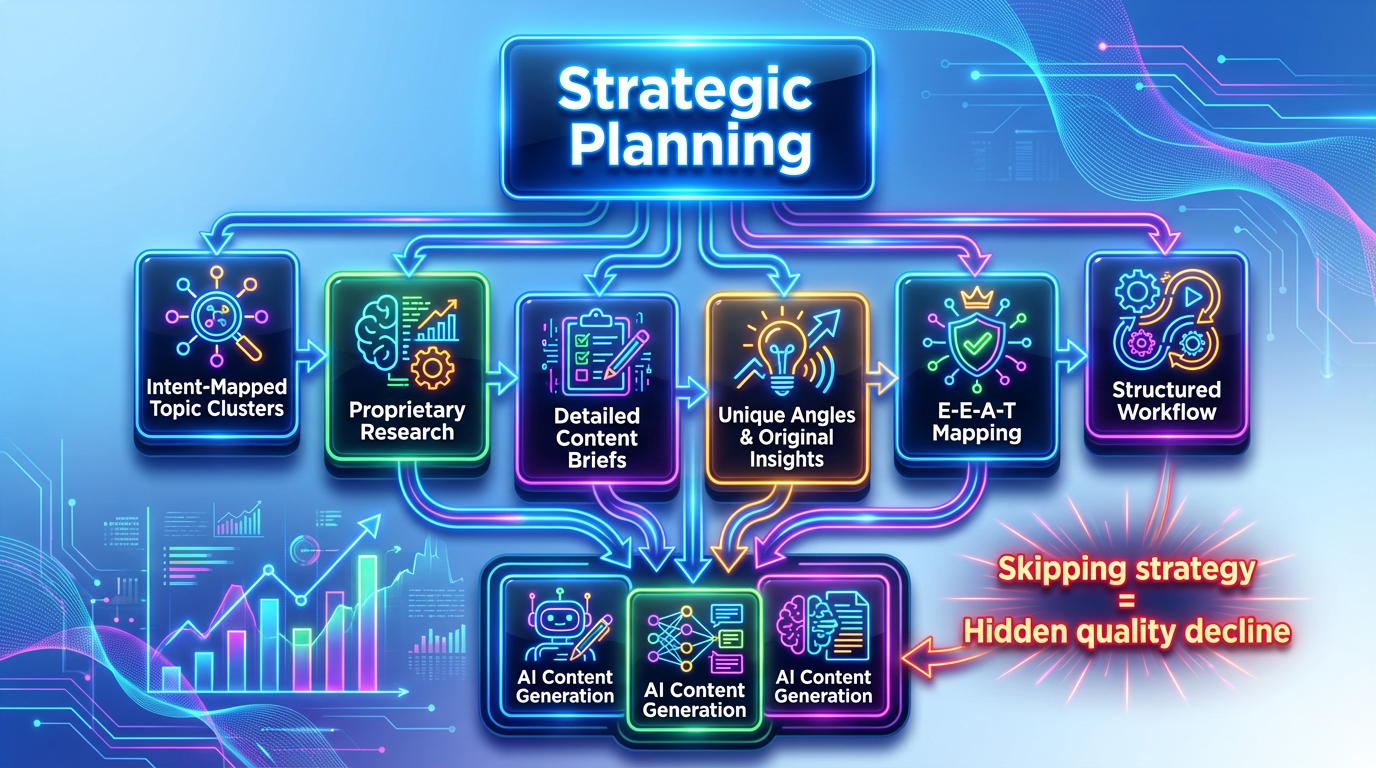
Automated generation doesn't reduce the volume of strategic thought required. It redistributes where that thought occurs. Before any tool generates a single word, strategists and editors must complete the grounded strategy work that determines whether the output will matter.
This strategy phase requires teams to build intent-mapped topic clusters based on proprietary research rather than keyword volume alone. Editors must write detailed content briefs that specify unique angles, required original insights, and differentiation from existing material. Strategists also map each planned piece against Experience, Expertise, Authoritativeness, and Trustworthiness (E-E-A-T) criteria to identify which assets require firsthand experience, cited expertise, or authoritative validation. An effective AI content strategy starts here and not at the generation step.
Brility Digital's analysis of the 2026 marketing landscape argues that AI isn't replacing great marketers. It exposes those who never had strategy or originality. Organizations that cut this strategy phase to maximize production speed typically discover that quantity masks quality decline. The structure of the strategy process is the single highest-leverage investment in AI content creation. Every dollar and hour spent on briefs, angle development, and topic clusters pays returns across every tier of production when teams use structured workflows.
Workflows From Brief to Published Asset
A systematic production workflow turns strategic plans into published AI marketing content. Each stage has a defined owner, specific deliverables, and clear handoff criteria. The control that this structure provides prevents the quality drift that plagues teams that scale without documented processes.
The five-stage workflow operates as follows:
-
Strategic brief creation: A strategist defines the angle, target audience, search intent, competitive differentiation, and required expertise level, and then documents these in a standardized brief template.
-
Draft generation: Tools eliminate the blank-page problem when they synthesize research and produce a structural foundation based on the brief's specifications. The team treats this output as raw material, not finished work.
-
Expert enhancement: Subject matter experts inject domain knowledge, verify factual claims, add original insights, and ensure the piece communicates something that a competitor's automated output can't replicate.
-
Brand voice and quality review: A dedicated editing pass checks voice consistency, brand guideline alignment, and quality gate clearance before any piece advances.
-
Final optimization: The team applies Search Engine Optimization (SEO), Generative Engine Optimization (GEO) structuring, metadata, and format adaptation for the target platform.
Teams reduce friction and strengthen output quality when they involve subject matter experts early during brief creation and angle selection rather than only at the fact-checking stage. A Semrush study found that human-written content is 8x more likely to rank first on Google than machine-generated content. This statistic underscores why expert enhancement isn't optional. Brand voice guidelines must also exist in documented, specific form before any automated tool enters the workflow. Without them, generated content dilutes voice gradually until the brand sounds like everyone else. Organizations protect their brand voice and support their workflows when they select the right tool ecosystems.
Tool Ecosystems Require Workflow Fit
The tools themselves matter less than how they serve each stage of the production process. Generation platforms like ChatGPT, Writer, and Jasper each occupy a different niche. They handle general-purpose drafting, brand-customized output, and marketing-specific copy. Visual and video tools such as Midjourney, Canva, and HeyGen handle image creation, editing, and multilingual dubbing. Repurposing platforms like Recast Studio convert long-form assets into short-form clips, while scheduling tools like Buffer and ContentStudio manage distribution across channels.
The rationale for tool organization by workflow function rather than feature comparison is practical. According to the Pedowitz Group, most B2B teams run 25 to 60 marketing technology tools, and the common middle falls between 35 and 45. That level of sprawl creates integration complexity, data silos, and spending that doesn't translate into better output. The 2026 consolidation trend reflects this insight. Teams collapse 10 to 15 overlapping subscriptions into three to five core platforms that map directly to their AI content creation workflow stages.
Expensive or feature-rich platforms don't automatically produce stronger results. An effective AI content strategy matches specific tool capabilities to concrete production needs at each tier. A mid-range tool that fits the workflow cleanly outperforms a premium tool that sits outside it. Selection discipline protects budgets and keeps operational focus on the system rather than the software. This operational focus helps organizations adapt their content for specific regions, such as the Middle East and North Africa.
Cultural Intelligence Scales MENA Campaigns
The MENA market represents one of the fastest-growing digital economies in the world. According to Mordor Intelligence, the GCC and Africa ICT market will reach a value of USD 327.48 billion in 2026. That scale creates enormous demand for AI marketing content, but the production challenge in this region extends far beyond translation.
Automated tools that learn primarily from English-language data struggle with Arabic's linguistic complexity. Research from Welo Data found that ChatGPT and Google Translate produced significant translation errors in scientific Arabic texts. These tools mistranslated technical terms and mishandled dialectal nuances. These failures illustrate why teams must build awareness of regional language variations, such as Egyptian, Gulf, and Levantine Arabic, into production workflows rather than treat them as post-production fixes.
Why Seasonal and Cultural Campaigns Still Require Human Review
Seasonal content amplifies this challenge. Ramadan campaigns, for example, require adaptation that goes beyond image swaps or calendar date adjustments. The emotional tone, cultural references, and values alignment in Ramadan content must reflect genuine understanding of the occasion's significance. Automated tools can handle format consistency and volume, but human reviewers with regional expertise must validate every asset for cultural compliance before publication.
This checkpoint isn't optional. A single misstep during a high-visibility cultural moment damages brand trust in ways that months of correct output can't repair. The structured hybrid model applies here with particular force, because cultural intelligence doesn't scale through automation alone. Organizations measure their performance after they deploy these culturally intelligent campaigns.
ROI Measurement Extends Beyond Vanity Metrics
The logic behind automated content performance measurement seems straightforward. Teams track traffic, count engagement, and report the numbers. But when production volume increases tenfold, attribution complexity grows proportionally, and simple metrics lose their meaning. A team that publishes 500 articles per month can't evaluate success the same way it did when it published 50.
According to Sopro.io, companies that use automated tools in marketing see a 20 to 30% higher Return on Investment than companies that rely on traditional methods alone. That gain only materializes, though, when measurement systems capture the right dimensions.
Teams with a mature AI content strategy track performance across four categories:
-
Content-influenced pipeline: Prospects who engage with content and enter the sales pipeline show performance through close rates and deal velocity.
-
Visibility metrics: Teams track share of voice on priority topics, prompt visibility in generative search, and citation rates across Large Language Models (LLMs).
-
Customer experience impact: This category includes repeat engagement rates, retention tied to content journeys, and support deflection from self-service resources.
-
Operational efficiency: Teams measure content reuse rates, cost per published asset, and time saved per production cycle.
Validation of the hybrid model's effectiveness requires integrated dashboards that connect Customer Relationship Management (CRM) data, marketing automation, and analytics into a unified view. Without this connection, teams report activity metrics that look impressive on slides but reveal nothing about revenue impact. Organizations make internal shifts before they measure this revenue impact and implement new workflows.
Organizational Shifts Drive Adoption Success
Technical infrastructure alone doesn't determine whether hybrid workflows take hold. The psychological barriers within teams often stall implementation before tools ever reach full deployment. Fear of the initial time investment, past experiences with failed technology rollouts, and discomfort with new routines create resistance that no software update can fix.
The data confirms this challenge. According to Arcade.dev, only 1% of U.S. firms that use automated tools can demonstrate real payback on their investment. That statistic doesn't reflect a technology failure. It reflects an organizational capability gap. Teams adopt tools but do not redesign workflows, stabilize data foundations, or align measurement with revenue outcomes. The result is scattered adoption that produces isolated efficiencies but no systemic improvement.
How XTRND Turns Hybrid Content Systems Into Real Operations
Many brands already understand the theory behind hybrid content production. They know that humans should lead strategy and judgment while automated tools handle research, drafting, and scale. The difficulty comes when they try to turn that idea into an actual operating system. Most teams still manage content through disconnected tools, informal review processes, and inconsistent handoffs between strategists, writers, editors, and distribution teams. As output grows, those gaps create delays, quality drift, and content that no longer sounds like the brand.
XTRND helps organizations close that gap. Instead of acting as another content platform, XTRND builds the structure around the tools and people already in place. The team connects strategic briefs, tiered production workflows, expert review, brand voice controls, and distribution into one repeatable process. That structure allows companies to scale output across blogs, landing pages, social content, multilingual campaigns, and regional markets like MENA without losing the quality and consistency that make hybrid systems work.
How Low-Risk Content Helps Teams Build AI Adoption and Long-Term Success
Teams build momentum with low-risk wins. Teams that begin with Tier 3 content, such as FAQs, glossary pages, and comparison tables, build confidence through visible results before they produce higher-stakes AI marketing content. Early successes create internal advocates who can champion broader adoption. The progression from simple use cases to complex workflows mirrors how any organizational capability develops.
Teams achieve strategic advantage through repeated small victories. Governance structures, training programs, and clear role definitions must grow alongside the technology. Capability without structure produces chaos at scale. Organizations achieve long-term success when they avoid this chaos.
Conclusion
To summarize, organizations face an important workflow design challenge rather than a technology selection problem when they scale AI content creation. These organizations gain a distinct competitive advantage in the modern market when they build structured operations. They also win in 2026 when they design tiered production frameworks, invest in strategic planning, and maintain human oversight.
Over the next twelve months, organizations with established hybrid workflows will widen their performance gap over teams that still experiment. Organizations that want to move beyond experimentation often work with partners like XTRND to turn tiered frameworks, quality checkpoints, and hybrid workflows into a repeatable content operation.