Introduction
For years, brands across the Middle East and North Africa faced a persistent production paradox. Strong creative ambition frequently clashed with local infrastructure gaps, and this forced companies to either outsource projects to Western studios or accept delayed timelines and inflated budgets. Traditional cinematic content production inherently relies on complex pipelines that struggle to keep pace with modern digital demands.
Today, AI filmmaking studios remove these historical barriers and enable brands across the region to produce cinematic visual content in days rather than months. As 49% of marketers already use AI for video daily, early adopters naturally gain an advantage over competitors who still rely on manual processes. The technology changes how teams approach visual storytelling and shifts the focus from managing logistics to directing creative vision. This shift helps organizations move past theoretical discussions and implement measurable operational changes. In the following sections, we detail exactly how these automated pipelines work, from compressed workflows and mobile-first formats to concrete cost breakdowns and practical steps to select the right production partner.
MENA Production Bottleneck
For most of the last decade, brands across the Middle East and North Africa faced an uncomfortable choice whenever they needed cinematic content. They could outsource to studios in Los Angeles or London and accept six-figure invoices, or they could produce locally and settle for timelines that stretched well past campaign deadlines. Neither path worked well. High-end post-production infrastructure remained concentrated in Western hubs, and the cost of shipping creative projects overseas left little room for iteration or experimentation.
Regional Investment Is Closing the Infrastructure Gap
That dynamic is shifting. Regional capital now flows directly into the infrastructure needed to close this gap. Wa'ed Ventures operates as Saudi Aramco's $500 million venture capital arm, and it invested in Resemble AI to accelerate the company's regional expansion. Saudi startups like Infobrim raised at a $3.5 million valuation, and Value Makers Studio launched VMS Accelerate in Cairo to support creators who build with automated tools. These investments signal that regional investors view an AI video production agency MENA as a viable and scalable business model.
This shift results in a clear path from concept to finished effective content that no longer depends on Western studio calendars. Projects that once took quarters now take weeks, and the accelerated adoption curve suggests the gap will only continue to narrow as AI filmmaking studios accelerate their timelines.
AI Filmmaking Studios Accelerate Timelines
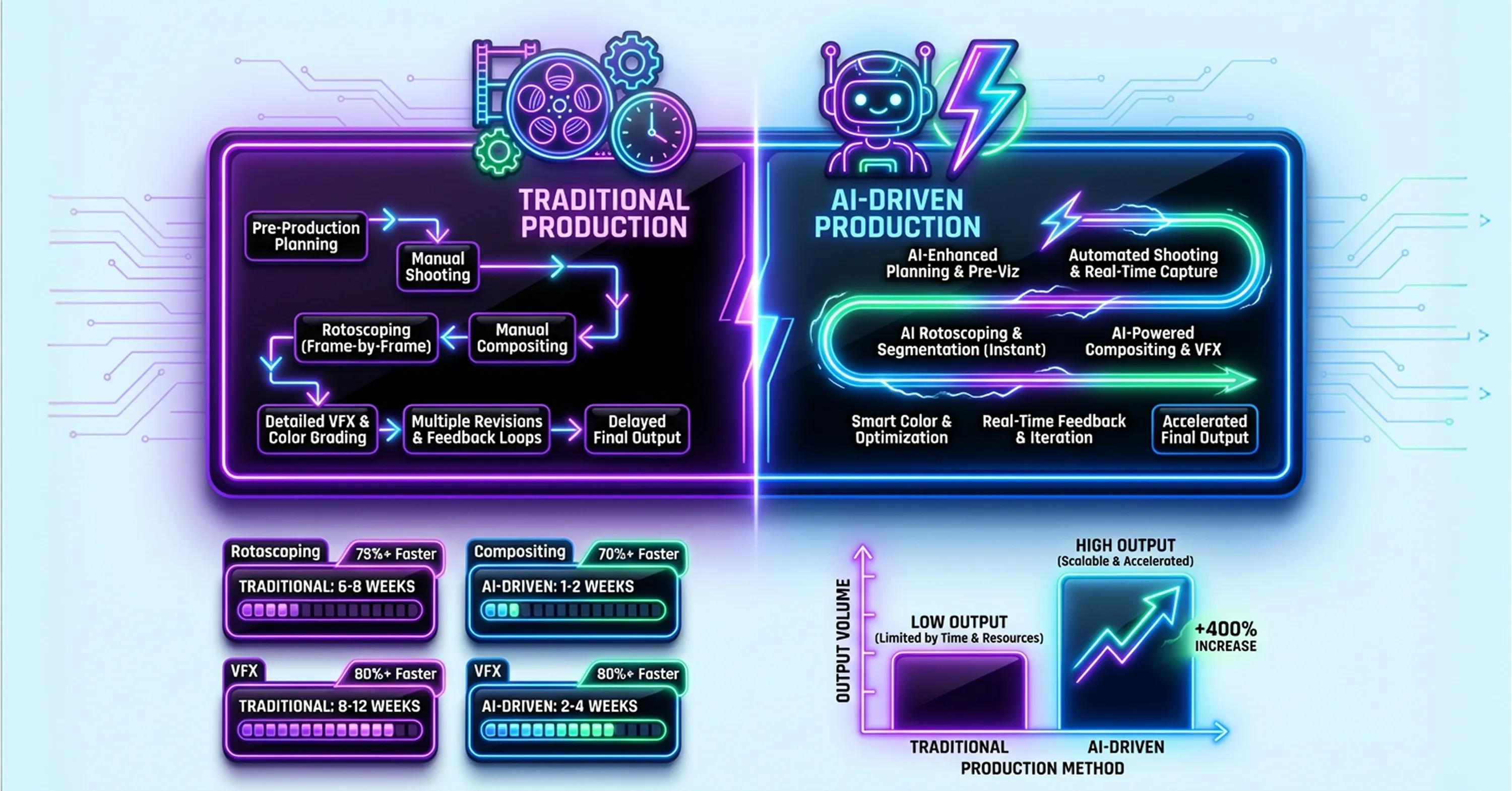
AI filmmaking studios compress production because they automate the stages that traditionally consume the most calendar time. Pre-visualization once required weeks of storyboard revisions and animatic production, but it now runs through generative models that produce shot-by-shot scene previews in hours. VFX compositing, color grading, and rendering follow the same pattern, and machine learning pipelines optimize each stage to handle repetitive frame-level tasks without human intervention on every iteration.
Why Faster Production Matters for Modern Campaigns

This operational shift creates a clear advantage when brands consider partnering with an AI video production agency MENA. A campaign that once required four to six months of post-production work can move from raw footage to delivery-ready assets in weeks. AI filmmaking studios do not eliminate creative oversight. They eliminate the idle time between creative decisions. Editors and directors spend less time waiting for renders and more time refining the story.
This efficient redistribution of effort matters because modern marketing demands volume alongside quality. A single campaign might need a hero film, six social cutdowns, and a dozen format variations within the same approval window, and post-production automation makes this volume possible.
Post-Production Automation
The most labor-intensive stages of post-production are exactly where automation provides the largest time savings. Rotoscoping involves the frame-by-frame process of isolating subjects from backgrounds, and it historically consumed six to eight weeks on a mid-complexity project. Automated pipelines reduce that timeline to one to two weeks. Compositing timelines drop from twelve to sixteen weeks down to six to eight. These improvements shrink overall post-production time by roughly half.
Netflix's Frankenstein demonstrated this capability at feature-film scale. The production completed its VFX pipeline in eight months rather than the typical twelve to eighteen because the team used agile automated workflows for tasks that would have required hundreds of additional artist-hours under a conventional approach. This benchmark matters because it proves the quality threshold satisfies theatrical release standards.
The same principles apply at smaller scales for branded content. Campaigns that require cinematic results can now reach that bar without the long timelines that once made such ambition impractical, and these time savings extend beyond visual elements to audio synchronization.
Audio Synchronization With Visual Elements
Traditional production treats audio and video as separate workstreams. A crew shoots footage, a sound team records dialogue and ambient audio in a studio, and a post-production house spends weeks aligning everything through manual synchronization and sound design passes. Each handoff introduces delays, revision cycles, and coordination overhead.
Modern automated systems generate motion, dialogue, and ambient sound within a single competent pipeline. When a scene renders, its corresponding audio elements render alongside it. The system matches footsteps to surface material, keys ambient environmental tones to the visual setting, and times dialogue precisely to lip movement. The output arrives pre-synchronized.
The elimination of separate audio recording sessions and post-sync handoffs removes the two to four weeks that traditional workflows typically add to a branded content project. For brands that produce content across multiple languages for MENA markets, this compression provides immense value because each localized version can generate matched audio and avoid new studio bookings. Teams find even more flexibility when they use mobile filmmaking studios.
Mobile Filmmaking Studio Selection
A mobile filmmaking studio combines smartphone-grade capture hardware with automated post-production software into a single workflow. A production team does not haul cameras, lighting rigs, and editing suites to a location. The team shoots on mobile devices and feeds footage directly into processing pipelines that handle stabilization, color correction, and effects.
This convergence removes the logistical overhead that delays content schedules. A brand activation in Dubai or a product launch in Riyadh avoids the need for a full crew setup day. This mobile approach turns same-day capture into same-week delivery. For social-first campaigns, that speed determines whether content stays relevant or arrives after the conversation has moved on.
Professionals measure the productive output of this model not just in individual assets but in creative volume. Teams generate multiple edits, angles, and format variations from a single shoot. This approach multiplies the return on every hour that teams spend on location, and it naturally supports a mobile-first approach with vertical formats.
Mobile-First With Vertical Formats
Mobile screens dominate content consumption across the Middle East and North Africa. The region consistently ranks among the highest globally for mobile video viewing. This means that content designed for desktop or landscape playback misses the way most audiences actually watch. This reality forces a format decision that shapes every production choice downstream.
Why Native Vertical Production Saves Time and Improves Results
Data confirms the shift is already underway. 59% of AI-generated videos now use the vertical format, and short-form vertical content delivers a 2.5x engagement advantage over longer horizontal alternatives. These numbers reflect how platforms like TikTok, Instagram Reels, and YouTube Shorts have restructured audience attention. A production setup that focuses on these formats produces assets that match the consumption environment from the start. This prevents cropping or reformatting after the fact.
For an automated video production agency that MENA brands work with, this structured approach to format selection represents an effective operational decision. Native vertical formats eliminate an entire revision layer and ensure that the final output performs where audiences spend their time. Brands that still default to landscape and retrofit for mobile lose both quality and speed in the conversion process. They also lose audience attention in the fraction of a second before a viewer scrolls past. Brands capture this attention when they combine native mobile formats with high cinematic quality.
VFX and Cinematic Quality
AI filmmaking studios have turned the most expensive post-production tasks into routine operations. Crowd generation once required physical extras or complex particle simulations, but it now runs through models that populate scenes with realistic digital figures in a fraction of the time. Background replacement follows the same logic. Production teams no longer book locations or construct sets. They feed reference imagery into generative systems that produce photorealistic environments and match the scene's lighting and perspective.
These AI-driven workflows extend beyond environment and crowd work into the finer details that separate branded content from amateur output. Cinematic controls such as dolly, crane, handheld, and zoom movements can now be specified at the prompt level, and shot durations stretch up to twenty seconds with consistent motion. Character consistency across scenes was an unreliable capability even a year ago, but it has matured into a production-grade tool. A brand mascot or spokesperson holds the same proportions, clothing, and facial features from one scene to the next.
Branded campaigns depend on visual continuity. A product launch film that shifts character appearance between shots erodes trust rather than builds it. Optimized consistency systems help AI filmmaking studios deliver the frame-level precision that traditional VFX houses achieved only through painstaking manual work and multi-week review cycles. The quality bar now matches theatrical standards, and the path from concept to final render has shortened dramatically, which directly lowers production costs.
How AI Filmmaking Studios Reduce Production Costs
The financial gap between traditional and automated production has grown wide enough to reshape how brands allocate creative budgets.
Concrete numbers illustrate the scale of this shift across content types:
-
YouTube shorts that previously cost $2,000–$8,000 now cost $50–$500, and this represents a 90–95% reduction.
-
Short films that ranged from $15,000–$60,000 drop to $1,000–$5,000.
-
Independent features that required $150,000–$500,000 compress to $15,000–$50,000.
These numbers reflect what AI filmmaking studios deliver today when automated pipelines handle the bulk of post-production labor.
How Lower Costs Expand Creative Possibilities
The more interesting consequence of this efficient cost structure is what happens to the freed budget. Traditional production economics forced brands to bet everything on a single creative direction. One concept survived the approval process, one version got produced, and the campaign either worked or it did not. Accelerated timelines and lower per-asset costs invert that constraint entirely.
Production teams now move faster than most client approval cycles. Studios previously presented three storyboard concepts and produced the approved winner, but they can now deliver three fully executed versions. Decision-makers evaluate finished work rather than static mockups, and performance data replaces guesswork. This shift from "pick one idea and hope" to "test several directions and measure" changes the creative risk profile for every campaign, but success still requires careful partner evaluation.
Partner Evaluation and Trust
The choice of a production partner determines whether automated tools deliver on their promise or create new headaches. The distinction between a competent AI video production agency mena and a vendor that sells raw AI output comes down to one factor. Human creative direction layers over automated execution.
An MIT Sloan study found that consumers slightly prefer AI-generated content when they do not know its origin, but they value human involvement once the production method is disclosed. This finding carries a practical lesson. Brands that position AI to enhance human creativity rather than replace it align with how audiences actually respond.
How to Evaluate an AI Video Production Partner
Choosing the right partner matters as much as choosing the technology itself. Many agencies market themselves as AI production specialists, but some simply resell automated outputs without adding meaningful creative direction or strategic oversight. Brands need a partner that understands both cinematic storytelling and the operational realities of modern content production. The strongest studios combine automation with experienced human teams who can protect brand identity, maintain quality, and deliver reliable results at scale.
Specific criteria separate serious operators from tool resellers for a full-service studio or a mobile filmmaking studio operation:
-
Creative oversight ensures that directors, editors, and brand strategists guide every project, and AI handles execution rather than decision-making.
-
Quality gates establish defined review stages for human eyes to approve output before delivery.
-
Brand consistency systems rely on documented style guides that enforce rules across every asset, so character design, color palettes, and tone remain uniform.
-
Transparent cost structures provide clear pricing that explains what automation handles and where human hours apply.
The best partners change briefs into smooth production plans that account for format, platform, and audience from the first conversation.
Brands that adopt these workflows early build content libraries, refine their visual language, and claim audience attention. Early adoption helps companies set the production standards in their respective industries and overcome historical production bottlenecks.
Why Brands in MENA Turn to XTRND for Cinematic AI Production
Many agencies in the region now advertise artificial intelligence capabilities, but most still follow the same production model with different software. They generate clips quickly, yet they still depend on slow approvals, disconnected vendors, and workflows built for traditional production timelines. XTRND was built specifically for the faster, more flexible model that MENA brands now need. The team combines cinematic direction, automated post-production, mobile-first formats, and localized campaign adaptation inside one production workflow.
Instead of treating AI as a shortcut, XTRND uses it to remove the delays that normally slow a project down. A campaign can move from concept to hero film, vertical cutdowns, localized language versions, and social-first variations without waiting on separate crews, editors, and post-production houses. That structure allows brands across the Middle East and North Africa to produce cinematic-quality content faster, test more ideas, and maintain the visual consistency that traditional production often struggles to deliver at speed.
Conclusion
To summarize, the transition toward automated production pipelines resolves the historical bottlenecks that previously delayed regional campaigns and inflated budgets. Brands no longer need to depend on traditional hubs to achieve cinematic quality because the necessary infrastructure now exists entirely within software ecosystems. As the industry moves into 2026, the advantage lies in how effectively marketing teams can direct AI filmmaking studios toward a clear creative vision. Organizations that integrate these systems today will lead the entire industry tomorrow. Brands that want to move faster without sacrificing cinematic quality increasingly work with partners like XTRND, which combines AI filmmaking, regional market knowledge, and human creative direction inside one production system.