close-up of a human face blending with colorful abstract textures and mechanical elements, symbolizing AI and human integration

Automated Content Creation: How to Produce More Content Without Scaling Your Team

In this article, we explain how to build a production engine that multiplies publishing output without new hires. We discuss the transition from disjointed writing applications to integrated systems that manage research, drafting, and distribution. These strategies help companies meet growing content demands and reduce operational costs.

Content authorBy XTRNDPublished onReading time15 min read

Introduction

Companies face challenges as they attempt to satisfy growing content demands across multiple channels. These companies produce content for social media, email campaigns, blogs, sales enablement, and video platforms. At the same time, headcount growth has stalled across the industry. Even though 95% of B2B marketers use artificial intelligence, many companies report minimal value from those investments. Individual tools do not fix a broken process or increase meaningful output.

This dynamic forces companies to evaluate how they manage their operations. Automated content creation workflows present a practical solution that multiplies output, reduces costs, and maintains brand consistency without new hires. Successful organizations reject simple text generators and architect a hybrid model instead. In this model, technology handles production volume, and humans own strategy and quality. The following sections outline how to build this pipeline and treat content production as an integrated system.

Impossible Math Marketing Teams Face Today

Content demands have multiplied, but the teams responsible for meeting those demands haven't grown at the same rate. A Reborn CPG headcount study found that marketing headcount increased only 4.3% over a recent period while overall company headcount grew 11.5%. The gap between what marketing departments are expected to produce and the resources they receive to produce it widens every quarter.

Most organizations responded by purchasing AI tools. The logic seemed sound: if the team can't grow, give it technology that works faster. But adoption alone hasn't closed the gap. BCG research reveals that 60% of companies see minimal value from substantial AI investment. The reality is that bolting a text generator onto a fragmented production process doesn't fix the process. It just generates more unfinished drafts that still need ideation, editing, formatting, optimization, and distribution before they reach an audience.

Teams must look beyond tool capabilities and evaluate whether their surrounding systems actually produce finished, published work at scale. For most teams, these systems fail to do so because individual AI tools fail to solve the output problem.

Why Individual AI Tools Fail to Solve Output Problem

A team adopts a generative drafting tool, watches first-draft speed triple in week one, and then hits a wall by week four. The drafting bottleneck disappears, but new bottlenecks appear immediately upstream and downstream. Ideation still requires human judgment. Editing still requires manual review. Formatting, metadata tagging, Search Engine Optimization (SEO) alignment, and channel-specific adaptation still sit on someone's desk. The overall throughput barely changes because the slowest step in the chain, not the fastest, determines output.

Content automation tools purchased in isolation make this problem worse by creating an illusion of progress. Axel Tombereau's analysis of AI productivity found that 37% of productivity gains are lost to rework and verification. Teams draft faster, then spend just as long checking facts, correcting tone, and reformatting outputs for each channel. The net gain shrinks to almost nothing. This clarity about value leaks points toward a different conviction: the unit of investment should be the workflow, not the tool. A single application accelerates a single step, but an AI content workflow eliminates the handoff delays and rework loops that consume saved hours. This workflow then solves three core pain points.

How AI Content Workflow Solves Three Core Pain Points

An AI content workflow replaces the patchwork of disconnected tools with a single production system that moves content from idea to published asset through linked stages. Each stage feeds the next automatically, and this precision in handoffs addresses the three problems that stall most content operations: slow time-to-publish, high per-piece cost, and inconsistent brand voice across channels.

When these three pain points persist, even talented teams fall behind on publishing targets. A missed deadline on one blog post cascades into a delayed email campaign, a postponed social series, and a sales team left without fresh collateral. Treating each pain point in isolation adds complexity without resolving the root cause. For example, buying a faster drafting tool for speed, hiring a freelancer for cost, and running a brand workshop for consistency fail to fix the disconnected process.

A connected workflow brings all three pain points under a single command structure. Speed improves because stages trigger automatically. Cost drops because machines handle volume. Consistency holds because the workflow enforces brand rules at every stage rather than just at the final review. This process secures three specific gains, and the first gain involves a faster speed to market.

Faster Speed to Market

Traditional content production moves through a relay of handoffs: brief to writer, writer to editor, editor to designer, designer to publisher. Each handoff introduces waiting time, and the cumulative delay often stretches a single blog post from concept to publication across two or three weeks.

Event-driven automation compresses this timeline from weeks to hours. When a draft reaches a "complete" status, the system automatically triggers the next stage, whether that's an editorial review queue, an SEO optimization pass, or a scheduling action. This approach drops dead time between steps to near zero, and this speed directly leads to lower production costs.

Lower Production Costs

Scaling content with freelancers or agencies carries a linear cost curve: twice the content costs roughly twice the money. Automation bends that curve. Ahrefs' cost analysis found that AI-generated content costs 4.7x less than human-written content on a per-piece basis. At enterprise scale, these savings compound dramatically. IBM reported $4.5 billion in savings by the end of 2025 because it applied automation across its own operations.

Content automation tools deliver the same principle to marketing departments operating at a smaller scale. The savings don't come from replacing writers entirely. These tools reduce manual labor in repetitive production tasks, such as formatting, resizing, metadata entry, and scheduling. This reduction allows departments to direct their human talent budget toward higher-value strategic work. This stability in cost structure allows teams to increase volume without requesting additional budget, and the system maintains strict brand consistency.

Strict Brand Consistency

Brand voice holds together when one or two writers produce all the content. It fractures when output scales across dozens of assets per week, multiple channels, and a mix of human and AI contributors. Magid's research on AI and brand communication warns about growing "voice drift" risks as teams lean on AI acceleration without governance.

An AI content workflow enforces uniformity by embedding brand rules directly into the production pipeline. AI-driven workflows can be trained on a company's existing content library, and they apply tone, vocabulary, and structural guidelines to every piece that passes through the system. Every piece sounds like it came from the same editorial voice regardless of the author, and this consistency enables a successful hybrid model for automated content creation.

Hybrid Model for Automated Content Creation

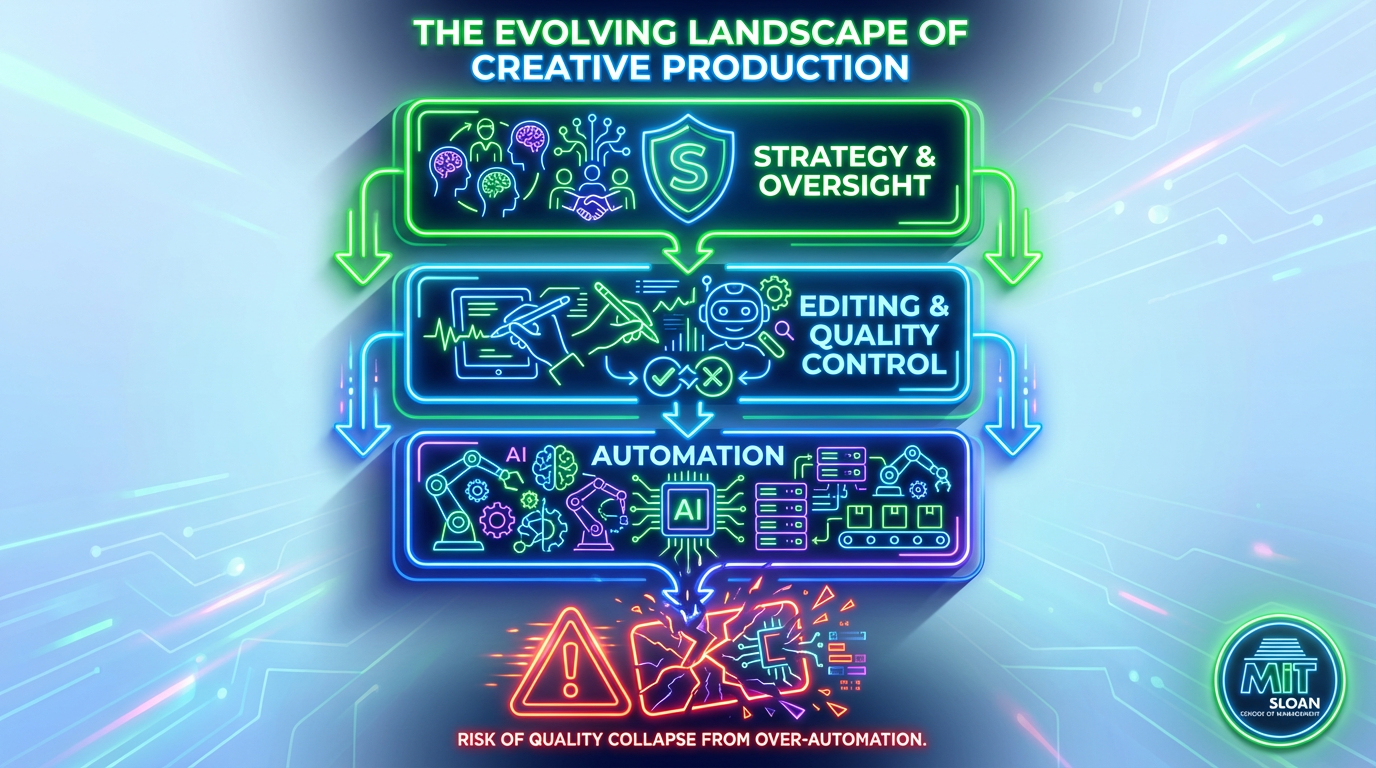
Symmetrical neon-glow infographic with three glossy cards on a gradient background, depicting strategy, editing, and automation themes.

Automated content creation works when the division of labor between humans and machines follows a deliberate logic rather than an ad hoc "let AI try it and see" approach. Research from MIT Sloan found that people prefer AI-generated content when unaware of its source, and this finding suggests that quality isn't the problem. The actual problem involves knowing where AI quality holds up and assigning tasks accordingly.

A practical task matrix divides content production into three tiers based on the mastery each task demands:

  1. Fully automated tasks include content repurposing across formats, scheduling and distribution, metadata tagging, and basic SEO optimization. These tasks follow predictable rules and benefit from speed and consistency over creativity.

  2. Human-in-the-loop tasks include first-draft generation, data-driven topic selection, and brand voice fine-tuning. For these tasks, AI drafts while a human edits, AI surfaces trends while a human chooses topics, and teams periodically recalibrate models against editorial standards.

  3. Human-led tasks include strategic narrative and positioning, original research and thought leadership, final editorial approval, and stakeholder or executive messaging. These tasks require judgment, empathy, and organizational context that AI cannot reliably provide.

This framework prevents the "automate everything" trap. Teams that push AI into tier-three tasks quickly see quality collapse, and this collapse erodes audience trust in ways that take months to repair. The discipline lies in respecting the boundaries between tiers, and teams maintain this discipline when they build an end-to-end pipeline structure.

End-to-End Pipeline Structure

A production pipeline needs structure at every stage, from the moment a topic surfaces to the moment a finished asset reaches an audience. Teams must document every integration point when they build this pipeline. This documentation ensures that automated content creation flows without manual intervention between stages, and it allows teams to issue change briefs quickly when strategy shifts.

The following breakdown maps each stage to specific tool categories and explains the capability each stage demands:

  • Research and ideation: Perplexity provides source-linked research summaries. Claude or ChatGPT brainstorm angles from a seed topic. News monitoring APIs and social listening tools surface trending subjects before competitors notice them.

  • Creation and drafting: Jasper generates brand-governed first drafts. ChatGPT handles versatile general drafting. Writesonic or Copy.ai produce high-volume short-form variants for email subject lines, ad copy, and social snippets.

  • Optimization: SurferSEO or Clearscope align drafts with search intent. Grammarly or Hemingway improve readability. Brand voice checkers compare each draft against the company's style guide before it advances.

  • Visual production: Canva Magic Studio creates batch social graphics. DALL-E or Adobe Firefly generate custom imagery. Descript or Lumen5 convert written content into short-form video.

  • Distribution and repurposing: Buffer schedules posts across platforms. Repurpose.io adapts a single asset into platform-native formats automatically. Make or n8n orchestrate the entire workflow and trigger each stage when the previous one completes.

Automation tools at each stage should be evaluated on four criteria: transparent pricing, adjustable tone and workflow controls, reliability under volume, and integration capability with the rest of the pipeline. An isolated tool recreates the same bottleneck problem that individual AI writing tools cause. Teams avoid these bottlenecks and maximize content value when they apply the 1-10-100 distribution rule.

1-10-100 Distribution Rule

Most content teams spend the bulk of their energy on content creation and almost no energy on distribution. These teams have a backwards ratio. George Labovitz and Yu Sang Chang originally applied the 1-10-100 rule to data quality. This rule states that poor data quality costs $1 to verify at the point of entry, $10 to fix later, and $100 if left unaddressed. Content teams can apply the same principle to content. A blog post takes four hours to research and write, but it delivers almost no return if the team spends zero time on its adaptation and distribution across other channels.

An AI content workflow corrects this imbalance and automates the neglected stages. One finished blog post triggers the automatic generation of a LinkedIn summary, an email newsletter excerpt, a series of social snippets, and a sales one-pager. The workflow formats all these assets to platform-native specifications without manual rework. The optimization and distribution stages previously demanded hours, but now they demand minutes.

This shift restores the balance between creation and distribution. Human effort stays concentrated on producing the original insight. Automation handles the mechanical work and gets that insight in front of the right audiences in the right formats. At the same time, this system protects brand voice and authenticity at scale.

Brand Voice and Authenticity at Scale

Volume without governance produces noise. Automated content creation becomes a liability the moment output sounds generic, inconsistent, or disconnected from the brand's editorial identity. This concern is legitimate because audiences notice tone shifts between a blog post and a social update. This inconsistency erodes trust over time.

Practical governance starts before automation launches. Organizations establish a baseline voice when they train AI models on a library of 500 or more words of representative brand content. Custom instructions define vocabulary preferences, sentence structure, and topical boundaries to add a second layer of control. Quality gates then ensure reliability. These gates require human review of a statistically meaningful sample of automated output rather than every single piece. AirOps found that pages without quarterly updates are three times more likely to lose AI citations. This finding reinforces the need for ongoing recalibration rather than one-time setup.

These controls protect authenticity at scale. AI enforces the mechanical consistency that humans forget under deadline pressure. Editorial leads maintain the creative judgment and keep content from sounding robotic. Organizations commit to quality and precision in their output when they treat this governance layer as infrastructure, and this commitment drives automation ROI and pipeline impact.

Automation ROI and Pipeline Impact

Automated content creation produces many activity metrics. These metrics include more published posts, faster turnaround, and higher volume. None of those metrics matter to executive leadership unless they connect to revenue. The validation that automation works comes from three pipeline-facing indicators. These indicators include pipeline contribution, Customer Acquisition Cost efficiency, and conversion velocity.

Pipeline contribution measures what percentage of sales opportunities touched content before they converted. Customer Acquisition Cost efficiency tracks whether the cost of acquiring a customer drops as automation reduces per-piece production costs. Funnel conversion velocity measures how quickly prospects move from their first content engagement to a closed deal. Together, these three indicators tell a revenue story that activity metrics cannot tell.

Why Content Automation Only Works When Measurement Comes First

The evidence supports these expectations. A Series B SaaS company increased its organic pipeline four times over six months through content optimization and rapid iteration cycles. An AI content workflow enabled these rapid iteration cycles. Market Better's Return on Investment analysis found that the average yearly return for a well-run content campaign reaches $984,000. These numbers represent actual results rather than theoretical projections. These results happen when measurement infrastructure exists before automation launches.

Success depends on the construction of that measurement layer first. Some teams launch automation without tracking pipeline impact. These teams generate more content, but they cannot prove the value of their content. Unproven programs lose budget in the next planning cycle, and this financial risk forces organizations to evaluate the build versus buy decision.

How XTRND Turns Content Automation Into Measurable Growth

Many companies already have access to AI writing tools, SEO software, and scheduling platforms. The real challenge is connecting those tools into a workflow that consistently produces finished, on-brand content. XTRND solves that problem by operating as an integrated AI creative studio rather than a standalone tool. The company combines strategy, AI-assisted drafting, brand governance, visual production, and multi-channel distribution into one managed system. This allows organizations to increase publishing output without increasing headcount.

One source asset can become an entire campaign. A single article can be transformed into LinkedIn posts, email copy, short-form video scripts, sales collateral, and branded creative while maintaining a consistent voice across every channel. Instead of spending months building infrastructure internally, companies can work with a partner like XTRND and begin producing measurable results within weeks. This distinction leads directly to the next question: whether to build a content automation pipeline in-house or outsource it to a team that already has one.

Build Versus Buy Decision

Organizations need process discipline, clean data infrastructure, governance frameworks, and months of iteration to build an internal automation pipeline. Some organizations have these prerequisites. Many organizations lack these prerequisites. A build without these prerequisites produces an expensive and half-finished system. This system frustrates the team and delays results.

The decision framework hinges on operational maturity. Organizations with established content operations, a dedicated marketing operations resource, and a six-to-twelve-month runway benefit from internal builds. The content automation tools and pipeline architecture from the earlier sections provide a complete blueprint. Internal builds offer long-term independence because the organization owns every integration point and customizes the pipeline freely.

When Outsourcing Content Production Makes More Sense Than Building In-House

Organizations without these prerequisites need scaled output within weeks rather than quarters. These organizations benefit when they outsource to a production partner that already operates the pipeline. An AI creative studio handles strategy, production, optimization, and distribution as a managed service. The team receives finished and published assets without the need to build or maintain infrastructure.

Either path leads to more published content, lower per-piece costs, and consistent brand voice without additional headcount. The right choice depends on how quickly results need to arrive and how much internal infrastructure already exists, and the conclusion summarizes these strategic points.

Conclusion

To summarize the major points, scaling publishing output involves a workflow architecture problem rather than a tool selection issue. Automated content creation succeeds only when organizations adopt a hybrid operating model that delegates volume and distribution to machines while humans control strategy and insight. Organizations will successfully track future pipeline contribution and funnel velocity if they build proper measurement infrastructure before they launch these systems.

Companies can take the next step by evaluating internal capabilities to build this pipeline or by partnering with a service that produces cinematic brand reels and handles the entire production process without the infrastructure overhead. Organizations that need faster results may benefit from working with a partner such as XTRND, which already combines strategy, AI-assisted production, cinematic brand reels, and multi-channel distribution into a single workflow.

You must show your writers that this technology handles repetitive chores and does not replace human ingenuity. Automated content creation removes manual work and gives your team time to focus on strategy. You should offer training so your writers don't fear this technology and remain in control.

You must select enterprise platforms that don't train public models on your proprietary information. Your IT department needs to review the privacy policies of every tool before you connect them to your pipeline. Companies like null provide private environments that keep your corporate knowledge separate from public databases.

You can translate materials in your workflow to reach international audiences. You build a dedicated branch in your pipeline that passes the approved English draft to a language model. The system translates the text and applies cultural nuances before it schedules the localized posts.

Your marketers must judge editorial quality, and they must know how to analyze data. They must learn how to write clear prompts and evaluate whether machine outputs align with your brand standards. They won't need coding skills, but they must understand how software applications connect with one another.

You avoid copyright issues when you treat machine outputs as a rough draft rather than a final version. Your editors must review and revise all text to add insights and human experiences. These revisions ensure your published materials remain original and legally yours.

Schedule a Meeting

Book a time that works best for you

You Might Also Like

Discover more insights and articles

Title:
Motion Graphics Company: How to Choose the Right Partner

Meta description:
Choose a motion graphics company that fits your brand so you can read portfolios and set scope before you hire.

Arti

Motion Graphics Company: How to Choose the Right Partner

This article is a practical guide for anyone commissioning animated brand content for the first time. It explains what a motion graphics company actually produces, how a real production process works, and the concrete criteria you can use to evaluate and shortlist a partner with confidence.

Title:
Animation agency: how to choose the right studio + checklist

Meta description:
Before you hire an animation agency, use this checklist to write briefs and vet studios so you keep your project

Animation agency: how to choose the right studio + checklist

This article is a practical buyer's guide for the person who got handed the job of hiring an animation agency without ever running a creative purchase before. It walks you through scoping your needs, writing a brief that produces comparable proposals, vetting studios on signals you can actually judge, and standardizing your contracts. By the end, you'll have a reusable checklist you can run for this hire and every one after it.

Title:
Production services: what they are, types, and a workflow checklist

Meta description:
Before you buy production services, learn the workflow. This guide helps you hire the right team and keep

Production services: what they are, types, and a workflow checklist

This article explains what production services mean in the media and content world and how their main types map to a workflow from brief to final handoff. By the end, you'll know which type your project needs and how to brief a partner with confidence.

Title:
Film and Television Production Companies: What They Do & How

Meta description:
Find film and television production companies that fit your project. You will learn their workflow so you can

Film and Television Production Companies: What They Do & How

This article explains how production companies work across the screen industry, from early development to final delivery. It walks through the vocabulary and company types before offering a workflow for shortlisting partners without getting misled by glossy rankings.