Close-up portrait of a person wearing a futuristic visor with glowing red light, featuring textured skin details and a cyberpunk aesthetic.

What Are AI Production Labels? The Future of Content Creation Explained

In this article, we examine the emergence of AI production labels and their fundamental differences from traditional production houses. We explain how regulatory mandates and evolving consumer behaviors require a structural shift in creative workflows. Finally, we provide strategic criteria to evaluate production partners in this new landscape.

Content authorBy XTRNDPublished onReading time17 min read

Introduction

The term "AI production labels" has emerged rapidly in 2026, yet it lacks a clear definition across the industry. This ambiguity leaves businesses uncertain about what this service category represents and how it differs from traditional production houses that simply add new software to legacy processes. A fundamental shift has occurred because three converging forces have created a structurally distinct production model. These forces include regulatory mandates that require synthetic media labeling, the maturation of cryptographic provenance infrastructure, and an authenticity paradox in consumer behavior. Organizations that adapt to these changes see significant benefits, as 80% of companies report that artificial intelligence improves their overall efficiency by up to 40%.

This new model demands its own category because it relies on different economics, variable team compositions, and built-in governance from the very beginning. We clarify the value of these labels by explaining what they are, how they operate, and why they matter for modern content creation. Companies evaluate specific operational factors to identify a creative partner that can navigate these complex and technology-driven workflows.

AI Production Labels as New Service Category

AI production labels operate as creative production partners, and they build their entire operating model around artificial intelligence workflows from the ground up. This distinction matters because it separates them from traditional production houses that simply adopt new software tools and keep their legacy processes intact. The difference isn't technological. It's structural.

Traditional agencies experiment with generative tools and layer them onto existing pipelines. They keep the same planning horizons, the same fixed teams, and the same linear cost models. AI production labels operate with different economics, variable team compositions, and governance frameworks from day one. This structural gap explains why new roles emerged that don't exist in conventional shops. According to APR's 2026 production analysis, positions like AI Workflow Producers, Prompt Engineers, and AI Supervisors now define the staffing architecture of these organizations.

Why Brands Often Misunderstand AI Production Labels

No authoritative industry source currently defines this service category with precision, and that content gap creates real confusion. Brands evaluate potential partners and often conflate these new production partners with physical product label generators, agencies that run ChatGPT experiments, or freelancers who sell prompt packages. Each of these is a different thing entirely. Clarity here builds confidence in procurement decisions, brings precision to partnership evaluations, and helps organizations understand the specific forces that created this new production model.

Converging Forces Behind New Production Model

Three forces arrived at roughly the same time, and their convergence created conditions that legacy production models can't address through incremental adaptation. Each force alone would have pressured traditional workflows. Together, they demand a structurally different approach to content creation.

The first force is regulatory. Governments and platforms now require transparent labeling of synthetic media, and these mandates carry enforcement consequences that go beyond gentle suggestions. The second force is technical. Cryptographic provenance infrastructure has matured to the point where producers can feasibly track every creative decision in a piece of content. The third force is behavioral. Consumer attitudes toward artificial intelligence content have shifted in ways that complicate any strategy that relies on fully synthetic output.

These three forces don't operate in isolation. Regulatory certainty around disclosure requirements makes provenance infrastructure commercially necessary, and consumer skepticism about synthetic content makes hybrid production models the only viable protection against brand risk. An individual analysis of each force clarifies why AI-native production partners emerged as a distinct category rather than a feature upgrade to existing agencies, and regulatory mandates represent the first of these forces.

Regulatory Mandates for Content Transparency

Platform policies and government regulations now enforce strict disclosure requirements for synthetic content. Google activated mandatory labeling across all advertising formats, and as of March 5, 2026, every synthetic advertisement must carry an AI Generated label or face the same enforcement consequences that apply to misrepresentation violations. The European Union's AI Act becomes enforceable in August 2026 and requires AI-generated media to include machine-readable markers.

These aren't aspirational guidelines. Account suspensions, ad disapprovals, and financial penalties represent the documented consequences of noncompliance. Any production partner that fails to embed labeling into its workflow creates direct legal liability for the brands it serves. Compliant operations separate themselves from vulnerable ones because they build safety into the production process from the start rather than retrofit it at the end, and this safety relies on the maturation of provenance infrastructure.

Maturation of Provenance Infrastructure

The technical backbone that enables compliance is the Coalition for Content Provenance and Authenticity (C2PA) Content Credentials standard. This framework attaches cryptographically signed and tamper-evident metadata to content at the moment of creation. It records model identity, prompts, parameters, reference images, and every subsequent edit, and this creates an auditable chain of custody that nobody can forge after the fact.

Major generative tools, such as DALL·E, Adobe Firefly, and Google Gemini, now attach Content Credentials automatically. Hardware manufacturers have followed. Google's Pixel 10, for example, supports C2PA Content Credentials natively across all photos that users take on the device. For any ai creative studio that operates at scale, this infrastructure isn't optional. It serves as the trust layer that makes compliant production possible without delays in creative output, and this trust addresses the growing authenticity paradox in consumer behavior.

Authenticity Paradox in Consumer Behavior

Production teams accelerate output with generative tools, but consumers have grown more skeptical of fully synthetic content. Research from Billion Dollar Boy found that only 26% of consumers now prefer generative AI creator content, and this represents a steep decline from 60% in 2023. Social platform algorithms reinforce this shift. Instagram now weights original content and comment depth over volume metrics, and LinkedIn analyzes engagement for substantive interaction rather than raw impressions.

Production economics favor artificial intelligence while audience sentiment penalizes it, and this paradox forces a strategic hybrid approach. Fully synthetic campaigns risk algorithmic demotion and audience distrust. Fully manual campaigns sacrifice speed and scale. The hybrid model succeeds because it uses artificial intelligence to add production value and preserves human-created content to drive audience connection through authenticity. Only production partners that structure their operations around this balance from inception can manage it consistently, and this structural requirement highlights the operational differences from traditional production houses.

Operational Differences From Traditional Production Houses

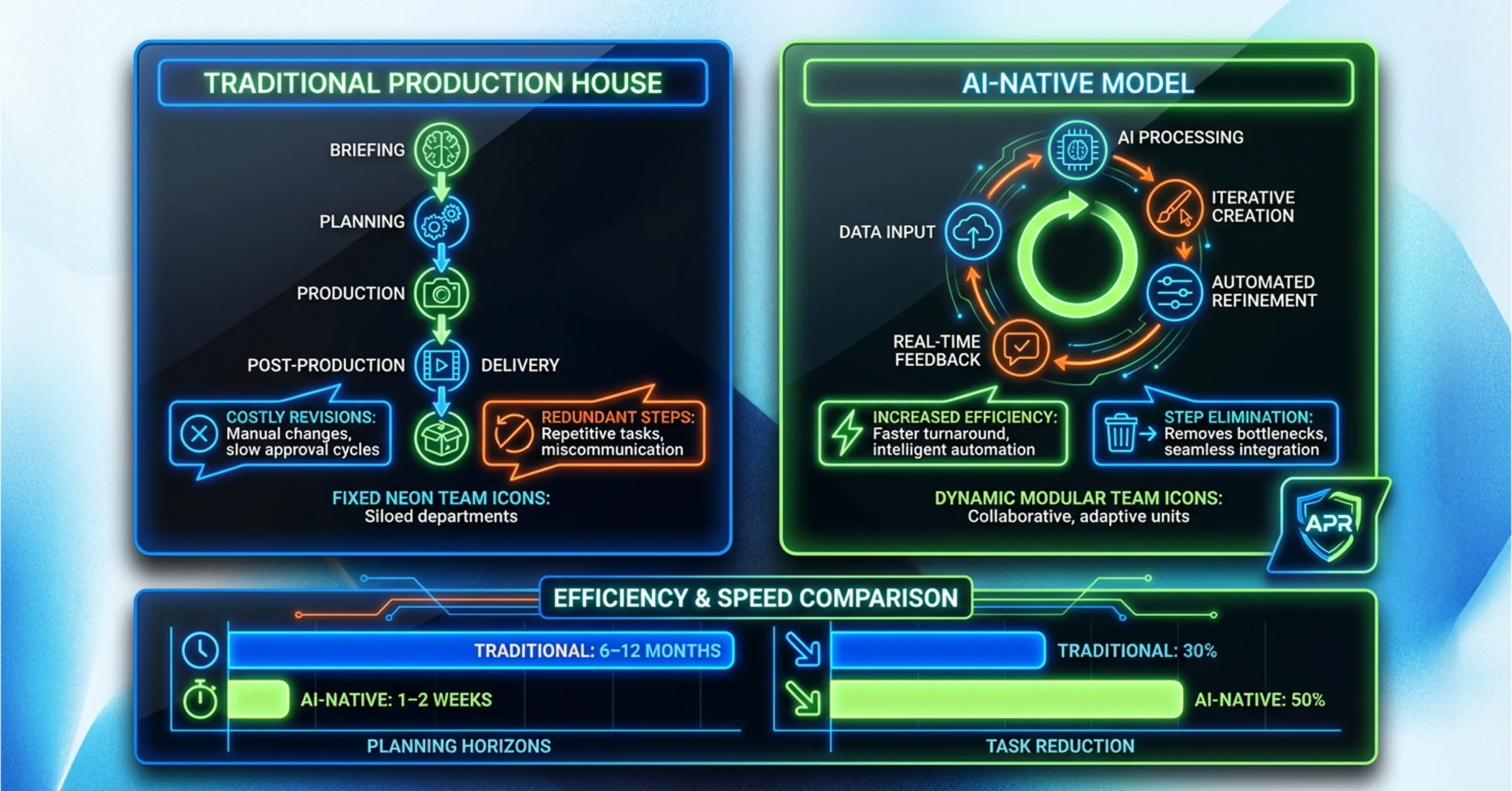
Side-by-side comparison of a traditional production workflow and an AI-native model, highlighting iterative automation, real-time feedback, reduced steps, and faster delivery timelines.

Traditional production houses follow a linear sequence of brief, concept, pre-production, shoot, post-production, and delivery. Each phase depends on the previous one, and late changes cascade into costly revisions. Planning horizons stretch six to twelve months. Teams remain fixed. Costs scale linearly with complexity.

AI-native production partners operate on a fundamentally different cadence. Planning horizons compress to one or two weeks. Team composition shifts per project, and managers pull in specialized roles as needed and scale them back when the phase ends. Per-iteration costs decrease rather than increase because each generation round refines the output and avoids a production clock reset. APR's 2026 analysis projects that AI-native processes will remove 30–50% of tasks entirely. They achieve this because they eliminate redundant steps that exist only to support legacy workflows.

Where AI-Native and Traditional Production Models Differ Most

The structural differences between traditional production houses and AI-native studios become much clearer when teams examine the day-to-day execution of a project. These organizations do not simply use different tools. They organize workflows differently, assign responsibilities differently, and manage approvals in entirely different ways. The result is a production model that moves faster, adapts more easily, and integrates oversight from the beginning rather than adding it at the end.

The operational differences between these models show up in several areas:

  • Workflow structure: Traditional houses manage vendors through a hierarchy. An AI creative studio orchestrates an ecosystem of tools, models, and human specialists that reconfigure per deliverable.

  • Governance integration: Compliance review happens at every stage of an AI-native workflow, and it does not serve as a final checkpoint before delivery.

  • Iteration speed: Concept variations move through an AI-native pipeline in days, but traditional houses need weeks to produce them.

  • Role architecture: AI Supervisors validate output quality and compliance in real time, and this function has no equivalent in conventional production.

The conviction that governance accelerates rather than constrains production separates AI-native agencies from traditional houses that add quality controls after the fact. When teams weave compliance into every step, it stops being a bottleneck and unlocks the core benefits of scalability, speed, and social-first content.

Core Benefits of Scalability, Speed, and Social-First Content

The practical advantages of AI-native production become clearest in the volume of creative variations, the production speed, and the alignment with social platform requirements. These aren't marginal improvements over traditional methods. They represent a different production reality.

Kraft Heinz demonstrated this shift when the company used its TasteMaker retrieval-augmented generation engine to slash design timelines from weeks to hours. The system didn't replace the creative team. It removed the production friction that prevented rapid tests of ideas. Ferrero achieved something similar at a different scale when it generated seven million unique Nutella jar designs that sold out within a month. This output created a personalization density that traditional production couldn't deliver at any budget.

Why AI-Native Workflows Are Built for Social-First Content

The operational value of these systems appears most clearly when brands need to create and distribute content across fast-moving social platforms. AI-native production partners optimize for constant iteration, immediate feedback, and multiple versions of the same campaign. They treat social requirements as the starting point rather than an afterthought.

An AI content production company that uses these workflows provides comfort in three specific operational areas:

  1. Agencies generate dozens of concept variations in the time traditional production delivers a handful, and they test each variation against real audience data before they commit to final production.

  2. Producers respond to cultural trends and platform algorithm shifts within days rather than months, and this keeps content relevant through its entire distribution window.

  3. Teams support nano-influencer and creator partnerships with rapid and customized asset turnaround that matches the speed these collaborations demand.

Social-first content creation offers refuge from a production model that treats social platforms as afterthought distribution channels. These agencies treat platform-native formats, aspect ratios, caption styles, and engagement patterns as primary design constraints rather than post-production adjustments, and this approach directly impacts the economic realities of AI-native workflows.

Economic Realities of AI-Native Workflows

The financial case for AI-native workflows rests on productivity gains rather than simple cost reduction. Surveys of corporate executives consistently point to efficiency improvements as the primary motivation to invest in generative tools. Cost savings follow, but they aren't the headline.

The per-asset economics tell a clear story. Admiral Media's analysis found that an AI content production company that operates with AI-native workflows produces assets at costs roughly 70% lower than traditional production on a per-unit basis. For high-volume and rapid-turnaround content like social advertisements, product variations, and platform-specific adaptations, the soundness of this model remains evident. A three-minute AI short film costs between $80 and $175 to produce, and this contrasts with approximately $5,000 for a traditionally produced independent piece of comparable length.

Why Lower Costs Do Not Always Mean Better Economics

But these numbers require precision in interpretation. Compute-heavy media generation isn't always economically viable. OpenAI's Sora application programming interface shutdown revealed that the cost per generated minute of video was unsustainable at commercial pricing, and this proves that artificial intelligence does not automatically guarantee cheaper results. For complex narrative work that demands perceived authenticity, traditional production retains clear advantages. The economic question isn't which model costs less. It focuses on which model delivers more value per dollar for a specific content type.

Roughly three-quarters of companies haven't yet generated meaningful returns from artificial intelligence investments. They fail to see returns because they bolt generative tools onto existing processes rather than change the workflows around them. The economic advantage materializes only when the workflow itself changes, and a hybrid human-AI model represents the most effective workflow change to resolve the authenticity paradox.

Why Fully Synthetic Content Creates an Authenticity Problem

The hybrid production model resolves a tension that fully synthetic and fully manual workflows fail to address. Platforms have made their preferences clear. Instagram weights original content and comment depth over volume metrics, and LinkedIn analyzes comments for substantive interaction rather than raw impressions. Algorithms now function as editorial gatekeepers, and they penalize content that lacks human fingerprints.

McDonald's Netherlands pulled an AI-generated advertisement after public backlash, and this event reminded marketers that audiences detect and reject inauthenticity. This outcome reinforced a broader industry certainty that synthetic-only content carries brand risk that no speed advantage can offset. Production partners build hybrid workflows to earn audience trust because they balance human creativity and machine efficiency from the start, and they do not patch these operations in after a crisis, as real-world campaign examples demonstrate.

How Hybrid Human-AI Workflows Build Trust and Performance

AI production labels solve this problem because they treat hybrid workflows as a structural default rather than an occasional adjustment. The practical approach reserves original photography and video capture for the primary content layer and deploys artificial intelligence for editing, caption drafting, scheduling, analytics, and variant generation.

Buffer's research supports this balance and shows that AI-assisted posts achieve 5.87% median engagement compared to 4.82% for non-AI posts. The performance advantage happens when teams optimize everything around the human element rather than replace it.

Real-World Campaign Examples and Applications

Several major campaigns illustrate what happens when brands use artificial intelligence to remove friction from specific production bottlenecks rather than replace human creativity outright. Heinz ran DALL·E prompts for "ketchup" and discovered that the generated images consistently resembled Heinz bottles. This insight informed subsequent creative strategy and became a campaign in itself. Burger King invited consumers to create custom Whoppers through AI-generated visuals and jingles. This approach democratized creativity and generated endless unique variations from a single concept.

Volvo used MidJourney, Runway, and ChatGPT to generate multi-modal assets that spanned visuals and narrative. Ferrero's seven million unique Nutella jar designs demonstrated personalization density that traditional production could not deliver at any budget. Each campaign shares a common thread because none replaced human input entirely. Each used artificial intelligence to accelerate a specific phase where manual effort created the most friction.

The financial outcomes reinforce this pattern. Salsify's analysis shows that organizations with artificial intelligence in their marketing workflows report 41% revenue increases and 32% reductions in customer acquisition costs. These results build confidence that AI-native production delivers measurable returns instead of just efficiency promises. An AI creative studio at this level maintains quality across thousands of variations because it designs workflows for volume from the beginning, and this volume requires strong provenance, labels, and compliance infrastructure.

Provenance, Labels, and Compliance Infrastructure

Content Credentials rely on the Coalition for Content Provenance and Authenticity standard and function as the compliance backbone for every legitimate AI production operation. These cryptographically signed metadata records attach to content at the moment of creation and cannot be forged, altered, or removed after the fact. They operate like tamper-evident seals on pharmaceutical packaging. If the seal is broken, the chain of custody becomes compromised and everyone in the supply chain knows it.

Why Compliance Infrastructure Is Now Mandatory for AI Production

The enforcement landscape has eliminated any ambiguity about whether compliance is optional. Google classifies unlabeled artificial intelligence content as misrepresentation, and this enforcement category applies to fake testimonials and deceptive advertising. The European Union's AI Act takes this further. Article 50 of the European Union's AI Act enforces machine-readable labels in August 2026. This law requires that AI-generated media remain detectable as artificially produced through embedded technical markers instead of just visible text disclaimers.

Any AI content production company that offers generative production services without integrated provenance infrastructure creates direct legal liability for the brands it serves. Safety in this context is not a feature or a selling point. It represents the minimum threshold for legitimate operation. The protection that Content Credentials provide extends beyond regulatory compliance to brand reputation because a single unlabeled asset that triggers enforcement action can damage years of accumulated audience goodwill, and this makes compliance a key factor in the evaluation criteria for production partners.

Evaluation Criteria for Production Partners

Companies need to evaluate structural capabilities rather than portfolio samples or client logos to select the right production partner in this environment. AI production labels that built governance into their workflows from inception operate differently from agencies that retrofitted compliance checkpoints onto existing processes. The distinction shows up in how they handle provenance, team composition, and failure scenarios.

Five Criteria for Selecting an AI Production Partner

Five areas deserve scrutiny during the evaluation process. First, provenance tracking should exist as a core workflow component rather than a post-production add-on. Second, the partner should demonstrate compliance with Google's March 2026 labeling requirements and preparation for the European Union AI Act's August 2026 enforcement date. Third, roles like AI Supervisors should validate output and compliance as part of the staffing model. Fourth, partners must demonstrate hybrid operational capability through previous work. This capability must scale artificial intelligence where it adds value and preserve human-created content where authenticity matters. Fifth, defined failure modes and fallback processes for degraded AI output quality should exist before they are needed. Agencies must not improvise these processes during a crisis, and organizations must apply specific criteria for an AI content production company to avoid such emergencies.

Why XTRND Represents the New AI Production Label Model

Many agencies now claim to use artificial intelligence, but most still follow a traditional production model with new software layered on top. They keep the same fixed teams, long planning cycles, and manual approval processes. The result is often faster output without any real change to how production works. XTRND operates differently because it was built as an AI-native production label from the start. The team combines AI Workflow Producers, prompt engineers, human creators, and quality reviewers inside a system designed for rapid iteration, compliance, and social-first content.

Every project moves through a structured workflow that includes human oversight, Content Credentials, approval checkpoints, and built-in safeguards for labeling requirements. This allows brands to generate more variations, move faster, and maintain audience trust without creating compliance risk. Instead of treating AI as an add-on, XTRND uses it as the production infrastructure behind the campaign.

Criteria for AI Content Production Company

The vendor selection process benefits from specific, verifiable proof points rather than general capability claims. A documented workflow walkthrough reveals whether compliance is structural or cosmetic. This walkthrough must show where Content Credentials attach, where human review occurs, and where systems flag AI-generated assets. Production volume data adds another layer of clarity. Admiral Media's analysis found that AI creative agencies produce 50 to 150 monthly variants compared to 5 to 15 from traditional agencies. This gap reflects fundamentally different operational architectures.

Measurable productivity improvements from previous engagements matter more than testimonials. An AI content production company should provide before-and-after timelines, team composition changes, and output quality metrics from comparable projects. Partners who build capabilities into operations can demonstrate them on request. Other partners likely retrofitted generative tools onto legacy processes, and that distinction determines whether the partnership delivers confidence or compliance risk and leads to the final conclusion.

Conclusion

To summarize, AI production labels represent a fundamentally different operating model rather than a simple rebrand of traditional production houses. They feature unique economics, variable team structures, and strict governance requirements that scale efficiently. Neither the traditional nor the artificial intelligence model is always better. The best choice depends entirely on specific project requirements, strict compliance constraints, and whether the content demands perceived authenticity or widespread personalization.

For the next steps, auditing current production bottlenecks against these evaluation criteria helps secure the right partner. Brands that want to scale without creating compliance or trust risks increasingly work with AI-native production labels like XTRND, which build transparency, provenance, and hybrid workflows into the process from the beginning.

You must secure commercial rights for all training data your vendor uses to create your media. Copyright laws protect original creators, so you face infringement lawsuits if you use unauthorized images. You should ask your partner to document their data sourcing methods to avoid these legal risks.

You can connect generative media outputs to your existing systems through standard programming interfaces. Most modern software platforms accept incoming metadata so your tracking records transfer smoothly. Your technical team just needs to map the provenance fields to keep your workflow unbroken.

You should track your energy usage because generative media creation consumes lots of electricity and increases your corporate carbon footprint. Regulators and consumers expect companies to maintain sustainable operations. Null helps you measure these environmental costs so you don't miss your climate goals.

Vendors protect your assets when they run closed models that don't share your private data with public servers. These closed models prevent other businesses from generating content that mimics your specific brand identity. You must sign enterprise agreements that force your vendors to keep your data secure.

You should start by teaching your team how to read provenance metadata and spot compliance risks. When you work with AI production labels, your staff needs practical experience with hybrid review processes. This training ensures your employees can evaluate vendor outputs and protect your brand reputation.

Schedule a Meeting

Book a time that works best for you