Videography Companies Near Me: How to Choose the Right Team

Content authorBy Rim AkawiPublished onReading time11 min read
Title:
Videography Companies Near Me: How to Choose the Right Team

Meta description:
Find videography companies near me with steps to compare briefs and quotes so you choose a local video team that f

This article is a practical framework for choosing among videography companies near me when you've never hired a local video partner before. It walks you through the scope and brief, then shows how to read portfolios before your questions and quote comparison lead to a confident shortlist.

Why the search feels overwhelming

You typed "videography companies near me" into a search bar, and the results came back fast. A dozen local teams, a handful of branded content studios, all with slick homepages and reels that look more or less the same to an untrained eye. You know what you want the video to do for the business. What you don't know is how to tell one of these teams apart from the next.

The problem is a lack of a reliable way to judge them. And that gap is where the money leaks out, because a first-time buyer without a filter overpays or sits through a re-shoot that a clearer conversation would have prevented. Video isn't cheap to get wrong. Most one-off business projects run under $11,500, and a bad hire can push you past that with nothing usable to show.

Here's the good news. Choosing well is a repeatable process that defines what you need and uses the same terms to compare who can deliver it. Get that right and the long list of videography companies near me shrinks to a few teams you'd actually trust. This article walks you through each step.

Define scope before you reach out

Before you contact a single company from a search for videography companies near me, decide what you're actually asking for. A vague request invites a vague quote, and vague quotes can't be compared against each other. Worse, they leave room for scope creep later, where the price you agreed to keeps climbing because nobody wrote down what "done" looked like. The clarity you build now is what saves you money down the line.

Start with the business goal. What is this video supposed to do? It can drive sign-ups, or it can explain a product on the About page where you introduce your team. Tech marketers, for instance, name explaining complex products as their top reason for making video, ahead of brand awareness. Your reason shapes everything that follows, so name it plainly.

Then work through the practical decisions that belong to you:

  • Who watches it, and whether they see it first on your site or through a paid Instagram slot

  • Rough length and any hard deadline you can't move

These aren't questions to hand off. A good production team will refine your answers, but they can't invent your goal or your deadline for you. When you know the audience and the platform, you've already ruled out formats that don't fit, which means the quotes you get back describe the same job. That's the foundation the rest of this process rests on.

Build a video project brief template

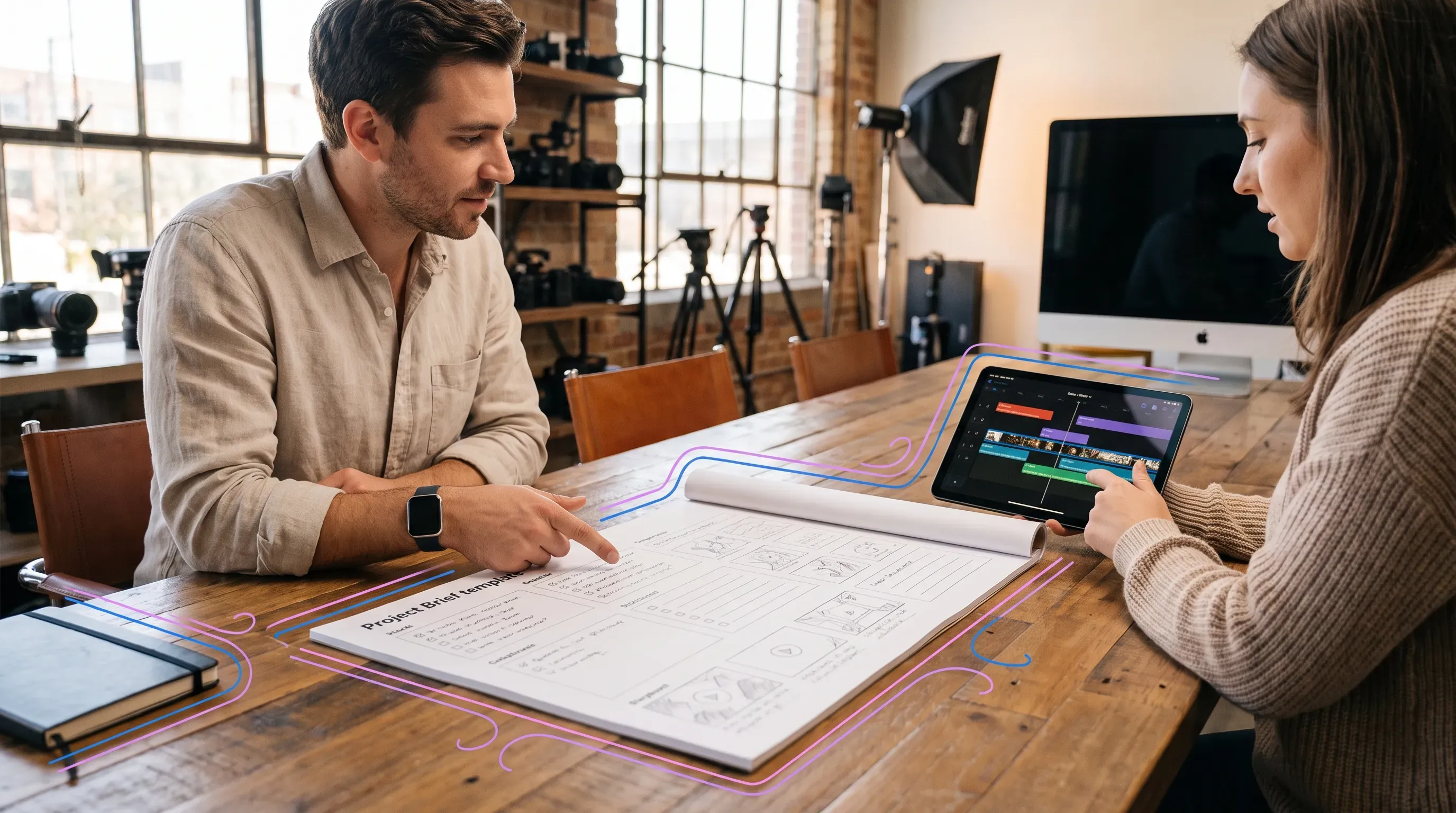
A collaborative workspace in a modern studio features a project brief template, with a content creator and project manager engaged in discussion.

Once your scope is clear, write it down. A video project brief template is one short document that captures your decisions and goes out to every company you contact. Same information, same terms. That's the whole point, because it's the only way to make the responses genuinely comparable instead of a pile of quotes answering slightly different jobs. Free versions exist, like the video production brief from Smartsheet, set up as a series of questions that walk you through goals and constraints.

A workable video project brief template covers these fields in plain terms:

  1. Project overview: a sentence or two on your company and what this video is for

  2. Objective and success measure: the business goal and how you'll know it worked

  3. Audience and where it will be published

  4. Up to three key messages and a link to two or three reference videos you like that show the tone

  5. Deliverables and formats, with the timeline and a budget range included

That budget range matters more than first-timers expect. As the team behind Simple.io's creative brief guide puts it, budget defined in the brief "prevents the scope creep that happens when budget isn't discussed until the brief is already in production." Naming a range tells a vendor what scale of work you can actually commission.

Filling out the video project brief template takes an afternoon at most. Sending the identical brief to each company you approach after searching for videography companies near me is what turns a confusing set of pitches into a real comparison. When you reuse the same video project brief template across every vendor, the differences in their answers become the signal you're looking for.

Want to build something that hits?

Ideas are cool. But action's cooler. Tell us about your project and let's create content that lands fast, loud, and strategic.

What to review in a portfolio

A showreel is designed to impress you. Your job is to look past the polish and read the work critically, because a reel that dazzles for ninety seconds tells you little about whether this team can deliver your specific project. Start by checking for a consistent style. A portfolio that jumps between wildly different looks can mean the company shoots whatever walks in the door rather than owning a craft. One that holds a recognizable point of view is a team that knows what it's good at.

Look for work in a format or industry close to yours. A studio with a strong wedding reel is a poor fit for a product explainer, even if it appears in a search for branded content studios, and the reverse is just as true. Branded content studios that regularly produce marketing videos for businesses will show you exactly that kind of work, which is a better signal than a beautiful film in a genre you'll never commission.

Look Beyond the Highlight Reel

Then watch the full pieces behind the highlight cuts stitched into the reel.

Three things reveal themselves over a complete video:

  • Production value: whether the lighting looks intentional and the footage is steady and sharp, rather than flat or shaky

  • Pacing and audio: whether the edit holds your attention or drags, and whether voices sound clean instead of muffled or echoey

Audio deserves real weight here. 87% of users say video quality affects how much they trust a brand, and poor sound is one of the fastest ways to lose a viewer. This portfolio review is your first hard filter. It's what takes a long list of videography companies near me and cuts it down to a realistic few worth a conversation.

Questions to ask videography companies near me

The portfolio gets a team onto your shortlist. The answers to your questions are what tell you whether they're a reliable partner. Asking well means knowing which questions surface how videography companies near me work and which reveal a red flag hiding behind a good reel. Group your questions so the conversation stays organized, and listen for clear, specific answers rather than smooth reassurance.

Process and timeline

Ask them to walk you through their steps from first concept to final cut. A typical workflow starts with pre-production, where the plan covers the script and schedule, then moves from the shoot into post-production for the edit and sound. You should hear the company describe those stages without hesitation.

The questions worth asking here:

  • What are your stages from kickoff to delivery, and who is my point of contact throughout?

  • What's the expected turnaround, and how do you handle delays if something slips?

A clear, repeatable process signals a team that has done this many times. Vague answers about timing are a warning, because a company that can't describe its own workflow will struggle to hold your deadline.

Want to build something that hits?

Ideas are cool. But action's cooler. Tell us about your project and let's create content that lands fast, loud, and strategic.

Rights, revisions, and deliverables

This is where first-time buyers get caught out most. Ownership and usage are not the same thing. As videographer Jon Conti explains, the creator keeps copyright while granting you a license to use the work, and "how you can use it should be clearly defined." So ask directly: who owns the finished footage, and what usage rights do I get? For business marketing, the baseline you want is a broad, royalty-free license covering your website and the channels where you distribute the video.

Then pin down the rest:

  • How many rounds of revisions are included, and what does an extra round cost?

  • Do I receive raw files or only the final edit, and what counts as out of scope?

Tie every answer back to the deliverables you listed in your brief. Revision limits and usage terms are exactly where an unwritten assumption turns into an invoice you didn't expect.

Team, gear, and references

Find out who's actually on set. Some branded content studios keep crew and equipment in-house, while others subcontract; either setup can work. What matters is that they can tell you who shows up and who edits your footage. Then ask whether they've handled projects like yours, and whether they'll share client references you can contact.

Don't get pulled into a spec sheet. A list of cameras and lenses tells you almost nothing about whether the finished video will land. Relevant experience and a reference who says "they hit our deadline and the video performed" are worth far more than the newest gear. Listen for whether the answers are concrete and whether they're willing to connect you with someone they've worked for.

Compare quotes without chasing the cheapest

Because every company from your shortlist of videography companies near me answered the same brief, the quotes that come back are finally comparable. Resist the pull toward the lowest number. The cheapest bid costs more once you add the revisions it didn't include or the re-shoot it forced. What looked like a saving becomes the most expensive option on the table.

Read each quote for what's in it and what's quietly left out. A freelancer charges $600 to $1,200 per day of filming while branded content studios quote a flat package, and the two aren't the same product even at a similar total. Check whether post-production and usage rights, including revision terms, are inside the price or waiting as line items. A number that seems low is low because half the job sits outside it.

Weigh price against portfolio fit and the reliability you've already assessed. You're comparing total value rather than a headline figure. Given that 93% of marketers report strong ROI from video, the goal is a result that pays back, and the team to hire is the one with the strongest fit rather than the smallest invoice.

Red flags to watch for

Before you commit to any team from a videography companies near me search, run a quick gut-check.

A few warning signs predict trouble later, and each one is worth pausing on:

  • No written scope or contract. Without it, there's no shared record of what "done" means, and disputes have no reference point. Videographer Jon Conti learned this the hard way and wrote that working without contracts "led to more disputes than I care to count."

  • Reluctance to share references or full past work. If they'll only show a highlight cut, ask what the finished pieces looked like.

  • A quote that dodges your brief. It means they either didn't read it or don't want to be measured against it.

  • Unclear ownership of footage, which becomes a problem the day you want to reuse it.

  • Pressure to book before your questions are answered. A team confident in its work gives you time to decide.

Any one of these on its own is a bad day. Two or more together is a pattern, and it's cheaper to notice it now than after the deposit clears.

Why businesses choose XTRND for video production

At XTRND, we believe successful video production starts long before filming begins. Great videos combine creative storytelling with a clear marketing strategy, ensuring every shot supports your business goals. That's why we guide clients through the entire process—from developing the concept and planning the production to filming, editing, and delivering content optimized for the platforms where it will be seen.

Whether you need a product video, brand story, recruitment campaign, or promotional content, we tailor every project to your audience, objectives, and budget instead of relying on one-size-fits-all solutions. If you're comparing videography companies near me, choose a partner that offers more than technical expertise. A structured process, transparent communication, and a strategic approach are what turn a professionally produced video into a valuable marketing asset that continues delivering results long after it's published.

Make your shortlist and reach out

You now have a process instead of a guess. Use your scope and brief to define the job, then let your questions and quote comparison test real value after the portfolio review narrows the list. That's how a shortlist gets made with confidence.

So take the next step. Send your video project brief template to your top two or three choices and request their availability. You'll arrive prepared, and that changes the conversation entirely. At XTRND, we help first-time buyers turn a search for videography companies near me into a clear, confident hire, so reach out with your brief and let's talk it through.

Want to build something that hits?

Ideas are cool. But action's cooler. Tell us about your project and let's create content that lands fast, loud, and strategic.

Bring your brief and target launch date. Decide who approves the video on your side before the call. A single decision-maker keeps feedback consistent because late feedback from extra reviewers can reset the edit and add costs.

A 25% to 50% deposit is common when booking production dates. The balance is often tied to the shoot date or final delivery, depending on the contract. Ask for the payment schedule in writing and check whether cancellation fees apply if your deadline or location changes.

Yes, you can hire an out-of-city team if the project doesn’t need frequent in-person planning. Local crews reduce travel fees and make location scouting easier. For interviews, events, or site footage, compare videography companies near me first, then include outside teams only if their portfolio matches your brief better.

Ask for the final video in the formats listed in your brief and a backup copy sized for your main platform. If you need captions or short cutdowns, name them as separate deliverables before signing. Raw footage needs a separate agreement because storage and usage rights affect the price.

Ask each reference whether the team met the deadline and handled revisions as agreed. A useful reference gives dates, project type, and one issue the team solved. If you contact Company after shortlisting, compare its references against the same criteria you use for other teams.

Schedule a Meeting

Book a time that works best for you

You Might Also Like

Discover more insights and articles

Title:
Videos for Companies: Types, Examples & a Planning Checklist

Meta description:
Choose videos for companies that fit your goal, then use a simple checklist to write a brief you can share with a

Videos for Companies: Types, Examples & a Planning Checklist

This article walks you through the main types of videos for companies and presents each one as a repeatable pattern you can copy. Then it hands you a short planning checklist to turn your chosen type into a brief you can pass to a freelancer or agency.

Title:
Corporate videography services: what to expect & how to choose

Meta description:
Learn how corporate videography services fit your approval process, so you can set review gates and control fee

Corporate videography services: what to expect & how to choose

This article walks you through the governance and approval side of commissioning a corporate video inside a mid-to-large organization. It covers how to map your reviewers and sequence the review gates, with guidance on feedback control and vendor selection within your company's constraints.

Title:
Corporate Filming: Definition, Workflow, and Shoot-Day Checklist

Meta description:
Use corporate filming workflow and shoot-day checks so you can plan your video project with confidence.

Arti

Corporate Filming: Definition, Workflow, and Shoot-Day Checklist

This article walks you through corporate filming from the first vague request to the moment you hand footage to an editor. You will learn what the term covers. You will also see how the workflow fits together and what to confirm on set so you can run a shoot without pretending to be a director.

Title:
Film Services: Definition, Scope Checklist, and Brief Template

Meta description:
Use this film services guide so you can define project scope and prepare a clear brief for the right provider.

Film Services: Definition, Scope Checklist, and Brief Template

This article defines what film services actually cover in a strict film-industry sense and draws the line between production and lab work. It also provides a scope checklist and a film services template you can fill in before you contact a single provider.

Book a call

Got a brief or just a thought? Share it with our team and let's create bold content built for speed.

Close