Introduction
Agency video production involves far more than cameras and editing software. This process operates as a managed service engagement that requires a documented governance system that covers scope, roles, approvals, and change control. Without these structures, ad hoc production processes fail to scale efficiently as content demands increase. Poor governance frequently leads to budget overruns, revision spirals, and misaligned expectations that derail projects. A Digital Applied report projects that 91% of businesses will use video as a marketing tool in 2026, and this trend makes formalized governance a necessity rather than an optional safeguard. To address these challenges, this article defines the production process and provides a pre-kickoff checklist that helps deliver work predictably and profitably.
Agency Video Production Beyond Standard Videos
Agency video production is a managed service, not a freelance upgrade. It requires strategic alignment, defined scope, contractual deliverables, structured approvals, and formal change management. Unlike freelancers, agencies coordinate multiple roles, manage accountability, and govern every phase from concept to delivery.
This structure matters as production scales. Informal processes break down when agencies run multiple projects with different stakeholders and approval chains. Small, undocumented changes can quickly lead to budget overruns, and scope creep remains a major profitability issue for many agencies.
Formal governance isn’t overhead—it’s the system that enables consistency, control, and accountability. As production accelerates, especially with evolving technologies, structured oversight becomes essential to keep projects on track.
Agency Video Production Process: Five Sequential Phases
Every agency video project follows five sequential phases that define where governance applies. The process begins with strategy discovery, where business goals, audience, messaging, and success metrics are defined and approved in a creative brief. Pre-production then translates this into a production plan covering scripts, storyboards, casting, locations, crew, and scheduling.
Production executes the shoot, where on-set decisions shape the quality of the raw material. Post-production transforms that material into finished content through editing, color grading, sound design, visual effects, and motion graphics, guided by structured review cycles and approval gates. The delivery phase finalizes the project by exporting platform-specific assets, applying metadata, and transferring or publishing the content.
Why Governance Matters at Every Phase
Each phase produces documentation that feeds the next phase. When governance fails at any point, the error compounds forward. According to Digital Applied, AI tools have cut production costs by 40% and dropped the median from $4,200 to $2,500 per finished minute. Lower per-unit costs have increased production volume, and this means governance failures now multiply across more concurrent projects. Precision at each phase gate remains mandatory when an agency manages a dozen deliverables simultaneously, and this precision requires mandatory pre-kickoff documentation.
Pre-Kickoff Documentation and Governance Framework
Alongside the SOW, the package includes a Project Charter that captures business context, target audiences, and success metrics. A RACI chart assigns Responsible, Accountable, Consulted, and Informed roles for every major task. According to the Project Management guide, a RACI matrix prevents confusion and overlapping duties and increases accountability across teams. The Project Schedule maps phase dates, milestone dates, and client-side activity dates. A Scope Matrix lists explicit inclusions and exclusions. The Revision Limits Policy, Communication Protocol, and Approval Gate Workflow round out the package.
This documentation ensures that both parties share the same expectations and establishes clear scope boundaries before the project begins.
Scope Boundaries: Inclusions Versus Exclusions
The scope matrix prevents the most common source of agency-client friction by aligning expectations on what is included and excluded. A well-structured matrix lists all elements by production phase, giving both parties a shared reference before work begins. Exclusions are not about upselling—they make boundaries explicit. If a client requests something like drone footage mid-shoot and it is listed as excluded, the request moves through a change order instead of becoming an ad hoc negotiation. This clarity stabilizes decision-making as creative needs evolve.
Inclusions guarantee deliverables and commitments. Exclusions define limits on effort and cost.Together, these elements create the control mechanism that keeps projects financially viable and still allows creative flexibility through documented change requests. When agencies explore how AI video creation tools intersect with traditional production workflows, they must clearly define the line between excluded custom work and specific inclusions.
Marketing Video Agency Inclusions
Agencies organize inclusions by production phase so every stakeholder can quickly locate covered items at each stage. Pre-production inclusions typically specify the number of strategy sessions, script draft iterations, storyboard complexity levels, location scouting scopes, and talent casting parameters. Production inclusions define crew size and roles, shoot day count, equipment packages, talent fees, travel, and on-set logistics. Post-production inclusions cover editing phases from first assembly through fine cut, motion graphics at a specified complexity tier, sound design, music licensing, color grading, and final delivery formats.
Each line item needs specificity. A single word like editing is too vague. A phrase that specifies three editing phases that include first assembly, rough cut, and fine cut is organized and enforceable. This level of detail in agency video production engagements prevents the ambiguity that leads to disputes. According to Colossyan, the production phase alone accounts for 40–55% of the budget, and this makes precise inclusion definitions and clear post-production boundaries necessary financial safeguards.
Post-Production Boundaries
The post-production exclusions require particular attention because this phase is where scope creep most frequently occurs. According to Colossyan, post-production accounts for 25–35% of the budget, and uncontrolled additions in this phase erode margins faster than any other phase.
Common post-production exclusions include visual effects beyond the budgeted complexity tier, custom music composition beyond the licensed library allowance, additional voiceover recording sessions, broadcast compliance and standards conversion work, and revision rounds beyond the included number. Each exclusion must be definitive and leave no room for interpretation. A phrase like additional visual effects is ambiguous. A phrase that specifies visual effects work that exceeds the budgeted complexity tier and includes 3D modeling, particle simulations, and photorealistic compositing draws a line that both parties can reference.
Any video production planning toolkit treats post-production boundaries as a financial control mechanism because one small tweak compounds into hours of unbilled labor without an exact deliverables specification.
Deliverables Versioning Matrix: Exact Deliverables Specification
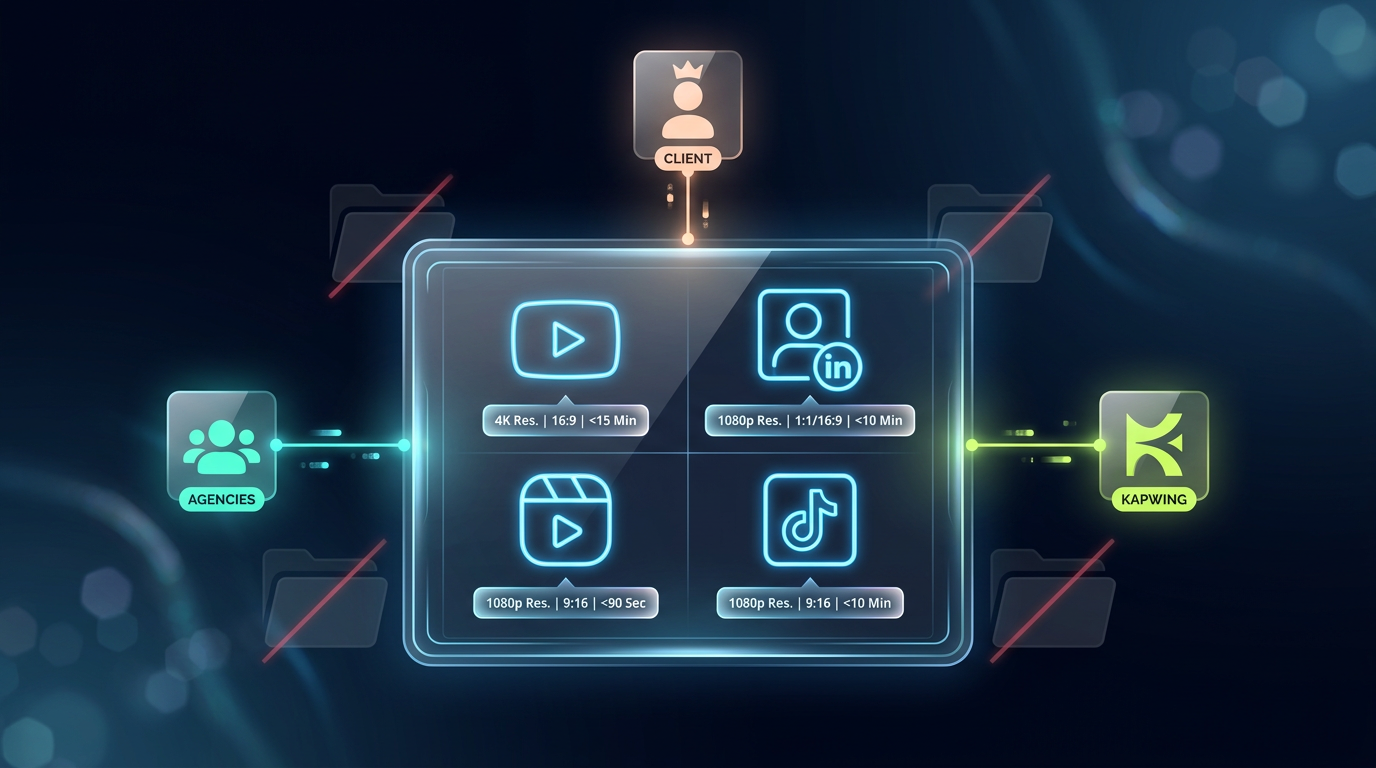
A deliverables versioning matrix eliminates ambiguity about what the client receives at project close. Without this matrix, final delivery means different things to different people, and agencies end up re-exporting files weeks after the project concludes.
A typical multi-platform campaign produces several distinct versions from a single master. The hero cut serves as the full-length broadcast-quality master at 1920×1080 resolution and 16:9 aspect ratio with complete color grading, sound mix, motion graphics, and visual effects. The YouTube cut shares the same resolution and aspect ratio but optimizes for the algorithm with chapters and metadata. The LinkedIn cut maintains 1920×1080 at 16:9 and caps at ten minutes with platform-optimized captions. Instagram Reels and TikTok cuts shift to 1080×1920 vertical format at 9:16 aspect ratio. According to Kapwing, TikTok's optimal resolution is 1080×1920 pixels with a 9:16 aspect ratio, and Instagram Reels follows the same specifications.
The Deliverables Matrix and Technical Specifications
The matrix also specifies whether shorter clips, B-roll extractions, audio-only versions, and standalone caption files in SubRip Text or Web Video Text Tracks format require separate change orders. The technical delivery specifications that include frame rate, color space, audio specifications, and codec types like H.264, ProRes, or DNxHD round out the precise documentation.
Any video production planning toolkit that omits the deliverables matrix leaves the most common source of post-delivery friction unaddressed. XTRND manages complex multi-platform deliverable matrices for businesses, and this process relies on clear decision-making authority assignments to ensure teams export every version to specification.
How XTRND Implements Production Governance at Scale
XTRND applies these governance frameworks in practice across multi-market video production pipelines. The team structures statement of work documents, deliverables matrices, and RACI models to align stakeholders before production begins, and enforces approval workflows and change control processes throughout execution. This approach allows XTRND to manage high-volume, multi-platform content delivery without scope drift or quality loss. By combining structured governance with modern production workflows, XTRND ensures that every asset—from initial concept to final export—meets defined specifications, timelines, and performance requirements.
RACI Roles: Decision-Making Authority Assignments
The RACI framework assigns four distinct roles to every project task, such as Responsible, Accountable, Consulted, and Informed. When applied to agency video production, this framework prevents decisions that stall because nobody knows who owns them, and it prevents decisions that conflict because multiple people believe they own them.
Every task row in the RACI chart needs at least one Responsible designation and at least one Accountable assignment. The number of Responsible designations per row stays minimal because spreading responsibility across too many people dilutes ownership. A production director typically carries the Responsible role for production execution decisions. The creative director or agency executive holds the Accountable role for strategic creative alignment. The marketing lead sits in the Consulted column on brand decisions, the legal team holds the Consulted role on regulatory content, and the finance team occupies the Informed column for budget status updates.

RACI Alignment by Phase and Pre-Kickoff Accountability
Teams organize the chart by project phase. Strategy and discovery tasks carry different RACI assignments than production tasks, and post-production tasks involve different stakeholders than delivery tasks. A single static chart that does not differentiate by phase forces people to scan irrelevant rows to find their responsibilities.
The most critical governance step in the entire RACI process is the pre-kickoff sign-off. Every person named on the chart acknowledges their assignments before the project begins. This sign-off creates documented accountability. If a bottleneck arises later because an assigned decision-maker is unavailable or unresponsive, the team references the signed chart rather than negotiates authority in real time. With this formal acknowledgment, the chart becomes an enforceable agreement that keeps decision-making authority clear across all approval workflows.
Approval Workflows: Stage Gates That Prevent Drift
Approval gates act as quality checkpoints that lock each project phase before the next begins. Without them, assumptions carry forward and small issues escalate into costly corrections.
-
Strategy gate: Client sign-off on direction, audience, messaging, and success metrics to establish the creative foundation.
-
Pre-production gate: Approval of script, storyboard, timeline, crew, locations, and key scope decisions.
-
Production gate: Confirmation that filming is complete, with end-of-day checks on multi-day shoots to ensure all required footage is captured.
-
Post-production gate: Sequential approvals (rough cut, graphics/VFX, color, sound, final master), each narrowing the scope of feedback.
-
Delivery gate: Final validation of all versions, metadata, and publishing readiness.
Each gate defines approval requirements, responsible decision-makers, timelines, and default outcomes. A standard approach includes a fixed review window (e.g., five days) and written sign-off, with projects progressing if no response is received.
An approval log records every submission, including version, date, approver, and conditions. This log serves as the project’s record of decisions and supports formal change control if disputes arise.
Change Control: Scope Modifications Without Project Disruption
Every video project encounters requests that fall outside the original scope. A process must exist to handle these requests without destabilizing the budget, timeline, and team.
A four-step change control process provides this stability. First, the requester documents the change formally and includes the date, the specific modification requested, the business rationale, and any dependencies on other deliverables or phases. Second, the agency analyzes the impact across four dimensions, such as scope, budget, timeline, and resources. Third, the decision-maker approves the change, rejects it, or approves it with modifications. Fourth, all project documentation updates to reflect the new baseline, and this includes the SOW, schedule, deliverables matrix, and budget.
The SOW contains specific change control language. This document establishes the mechanism before teams need it, and it includes a clause that requires written change requests for any scope modifications after pre-kickoff approval. The agency assesses the impact and provides a change order, and the team implements the change only after both parties approve and sign the order.
Revision Limits Plus Extra Invoices: Included Scope Versus Extra Costs
Most agencies include two to three revision rounds in the project fee and bill additional rounds hourly or at a per-round rate. For video production specifically, two to three cuts during post-production represent the industry standard, such as first assembly, rough cut, and fine cut, and each cut incorporates a round of client feedback.
The difference between a revision and a new direction causes the most disputes. A revision modifies elements within the agreed creative scope and strategic framework. A new direction fundamentally pivots the strategy, audience, concept, or creative approach. An adjustment to color warmth across a scene serves as a revision. A new direction involves a shift from a minimalist visual concept to a maximalist design. A change to a headline's wording represents a revision. A script rewrite for a different audience operates as a new direction. These lines stay clear when teams define them in advance.
Pre-Kickoff Checklist: Quality Gate Before Production Begins
The pre-kickoff checklist consolidates every governance element into a single verification sequence. This checklist functions as the final quality gate that determines whether a project launches with complete alignment or launches with gaps that surface as problems downstream.
-
The agency confirms the SOW signature from authorized representatives at least one week before the kickoff meeting.
-
The team verifies the Project Charter approval with the client decision-maker.
-
The agency presents the RACI Chart, reviews it line by line with all named stakeholders, and obtains signatures that acknowledge each assignment.
-
The team reviews the Project Schedule with the client and confirms that all phase dates and milestone dates are realistic.
-
The agency walks through the Scope Matrix and confirms mutual agreement on inclusions and exclusions.
-
The team confirms the Deliverables Versioning Matrix and specifies all file formats, resolutions, aspect ratios, and platform destinations.
Each step produces a documented record. The SOW signature creates a contractual baseline. The RACI sign-off creates an accountability record. The schedule review creates a shared commitment to dates. The scope matrix confirmation creates a mutual understanding of boundaries. The deliverables matrix confirmation eliminates post-delivery surprises.
Conclusion
A summary of the major points shows that successful agency video production relies on a unified governance system rather than isolated documents. This system groups the statement of work, scope matrix, deliverables list, RACI chart, approval workflow, change control process, and revision policy together to prevent project drift. The governance system also includes a pre-kickoff checklist that serves as the quality gate and ensures complete alignment before any camera work begins. A final review process within this framework captures lessons from completed engagements and improves profitability with every delivery.
XTRND serves as an expert in digital workflows and production systems. The organization provides a detailed guide on AI tools for content creation that helps build a strong base for scalable and high-quality video output. These structured workflow practices will shape the future of media production and guarantee smooth operations. The best next step requires an immediate review of the current governance system to update the necessary production documents.