Introduction
Generative video technology has reached a point where producing visual content takes minutes rather than weeks. However, businesses encounter a persistent barrier because they generate output that fails to capture meaningful engagement or deliver results. A workflow deficiency causes this problem rather than a technological limitation.
Companies treat new platforms as standalone solutions, and they expect the software to automate strategy alongside execution. These businesses do not see the essential connection between tool access and performance outcomes. Producing engaging content requires a disciplined structure that addresses the entire pipeline. A format-first approach dictates how companies conceive ideas, control quality, and distribute assets across platforms. This reliable process for AI video creation helps businesses convert unpredictable experimentation into consistent and high-performing output. This guide breaks down the precise steps needed to build that workflow.
Why Most Brands Stall at AI Video Creation
The default approach to generative video follows a predictable pattern. A team evaluates three or four platforms, runs a handful of test clips, and then stalls when the output doesn't convert. The problem isn't the software. The problem is that evaluation started with features instead of format requirements.
This is the tool-first trap. Teams compare resolution options, generation speed, and pricing tiers before defining what a finished asset should look like or where it will run. They skip the decisive step and fail to map their content needs to a production process, and the result is scattered experimentation that never compounds into a repeatable system. Practitioners across the industry observe that most failures result from strategy and process gaps rather than technical shortcomings. The technology works. The discipline around it often doesn't.
A format-first mindset reverses the sequence. It begins with the end deliverable and works backward through distribution requirements, quality standards, and tool selection. These deliverables include a 15-second reel, a direct-response advertisement, or a 90-second brand film. This precision in planning converts random output into assets that serve a specific business objective. The remaining sections of this guide map this end-to-end framework from ideation through production to distribution. This mapping helps teams build a scalable process that accommodates different content formats.
Three Formats, Three Workflows
A single production pipeline can't serve every content type because reels, ads, and brand films impose fundamentally different demands on speed, messaging, and visual quality.
Short form video AI workflows for social reels prioritize rapid turnaround and trend responsiveness. A reel lives or dies within 48 hours of a cultural moment, so the production cycle must compress from concept to publish in a single session. Industry data supports this urgency and shows that short-form clips under 60 seconds generate higher engagement by 2.5 times compared to their longer counterparts. This means the window for relevance is narrow and the volume requirement is high. Advertisements, by contrast, need message-testing velocity. A paid creative pipeline produces multiple variations of the same core concept and feeds performance data back into the next round of generation. Each variation includes a different call to action, hook, or visual treatment. Brand films sit at the opposite end of the spectrum. They demand narrative coherence across scenes, consistent character rendering, and a level of polish that tolerates fewer shortcuts.
The first step toward mastery of AI video production at scale requires teams to recognize these distinctions. Each format carries a different tolerance for the medium's current limitations. For example, character drift matters far less in a quick reel than in a cinematic brand piece. Teams eliminate the certainty that one workflow fits all when they design content strategies based on formats from the start, and this format-first approach directly influences the ideation phase.
Phase 1: Ideation That Plays to Strengths
Effective ideation for generative video starts with an honest inventory of what the technology handles well and where it still struggles. Generative systems excel at rapid visual iteration, style exploration, and variation output. A concept that requires dozens of aesthetic treatments plays directly to these strengths. These treatments include different color palettes, camera angles, or motion styles applied to the same narrative hook. Research indicates that these tools help teams 34 hours per week on production and editing. However, those savings only materialize when the original concept focuses on speed rather than an adaptation from a traditional production brief.
The authority of any ideation framework requires teams to acknowledge constraints alongside capabilities. Physics inconsistencies, character drift between scenes, and unpredictable object interactions remain common failure points. When teams plan around these issues during brainstorming, they prevent wasted generation cycles and avoid flaw discoveries mid-production. Successful teams think in concept clusters and fragment one core narrative idea into multiple format-specific executions from the start. For example, a single brand story about product durability becomes a five-second reel hook, a 30-second advertisement with a performance call to action, and a longer brand piece with sustained visual continuity. This structure ensures that AI video creation begins with purpose and produces well-defined concepts ready for the production phase.
Phase 2: Production Pipeline Orchestration
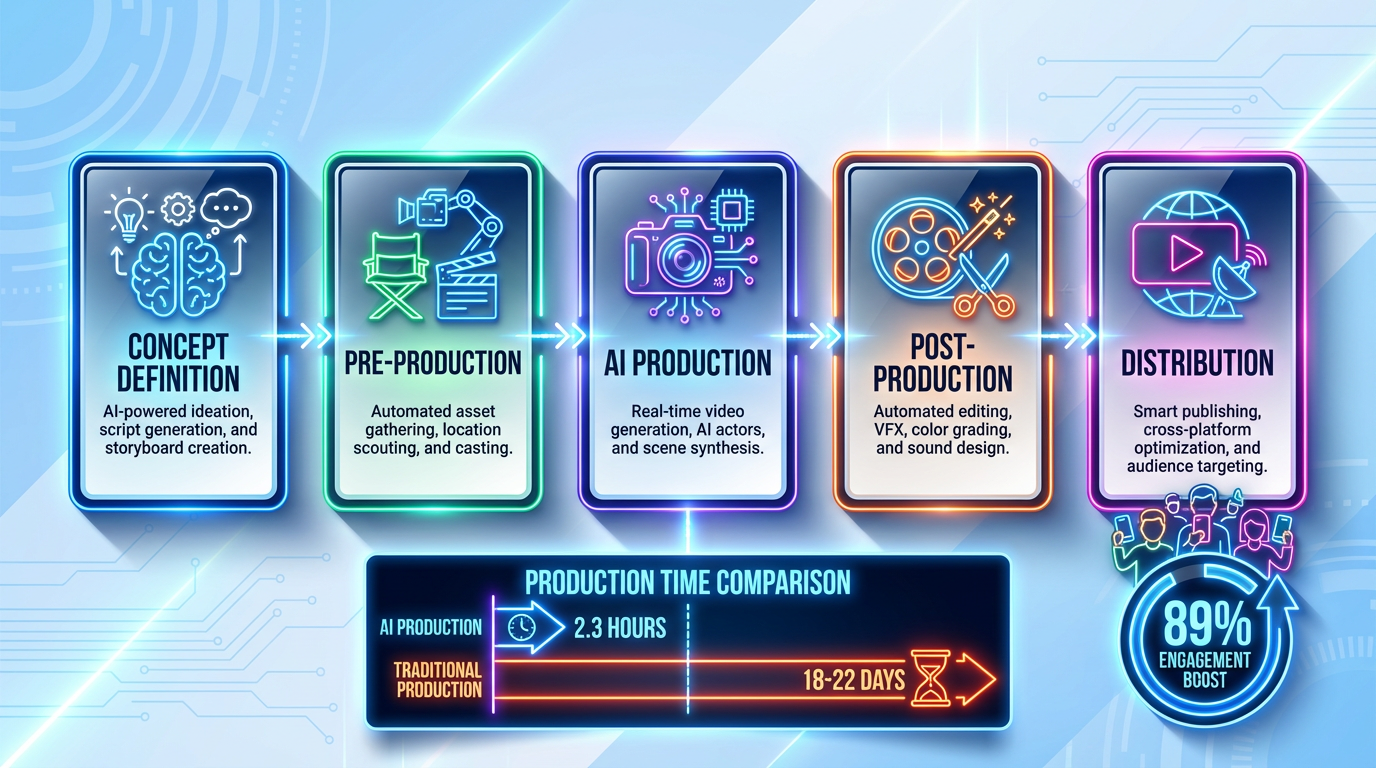
Once ideation defines the concepts and formats, production shifts to execution. Execution demands a structured sequence of decisions rather than freeform experimentation.
The production phase breaks into three areas, such as tool selection, prompt development, and quality control. Each area feeds the next. Software selection without clear prompt mechanics leads to wasted credits and inconsistent output. Prompt development without a quality framework produces clips that look impressive in isolation but fall apart across a campaign. AI video production at scale requires command over all three areas that must work in concert.
Teams that treat production as a linear assembly line and move from tool to prompt to review outperform those who bounce between platforms and hope for usable results. The structured studio workflows illustrate this principle. Repeatable processes deliver consistent assets, and ad hoc generation delivers occasional highlights buried in unusable footage. Building these repeatable processes requires teams to select the right tools first.
Tool Selection for Social Reels
Different platforms serve different format needs, and the alignment of software strengths with output requirements prevents costly misalignment.
Fast social-first platforms such as CapCut and Kling handle high-volume reel production where speed matters more than granular control. Runway and similar cinematic-grade systems offer the directorial control necessary for brand films that demand scene-level consistency. This distinction matters because production timelines differ dramatically by format. One agency case study found that AI-generated clips averaged 2.3 hours from concept to delivery, compared to 18 to 22 days for traditional production. That compression only holds when teams match the tool to the task and develop strong prompts for those tools.
Prompt Development Fundamentals
Strong prompts specify more than a subject. They define aspect ratio, pacing, emotional tone, lighting direction, and stylistic references with precision.
The difference between a usable generation and a wasted one often comes down to diagnostic iteration. When a clip fails, effective prompt engineers identify the specific element that broke, such as a lighting mismatch, an incorrect camera movement, or an unintended mood shift. They then adjust that single variable instead of a complete prompt rewrite. Toys"R"Us demonstrated the potential of disciplined prompt work when the company produced a 66-second commercial entirely with OpenAI's Sora text-to-video tool. The company achieved this result through systematic refinement across multiple rounds, and this refinement helps prevent visual errors like character drift.
Character Consistency and Quality Gates
Character drift across scenes remains one of the most visible signs of uncontrolled generation, and it erodes audience trust faster than almost any other artifact.
Reference image pinning and fine-tuning techniques help maintain visual continuity, but technology alone doesn't solve the problem. Teams need a quality gate framework that defines three categories for every generated clip. These categories include publishable, revisable, or abandoned. This framework prevents the common trap of endless iteration on a flawed concept. The stakes are real. Research shows that 89% of consumers have watched AI-generated content without recognition of its origin. This means the reliability threshold rests on audience perception and not on technical perfection. If a clip triggers the uncanny valley, no amount of revision fixes the underlying concept. Once a clip passes the quality gate, teams move it into the distribution phase.
Phase 3: Platform-Native Distribution Strategy
Production speed changes distribution from a scheduling exercise into a testing engine.
When a single creative asset takes weeks to produce, teams distribute conservatively and rely on one version per platform, minimal variation, and long campaign windows. When that same asset takes hours, the calculus shifts. Teams can deploy multiple creative variations across audience segments simultaneously and let performance data select the winners. This is where short form video AI workflows generate their strongest return on investment. Performance data supports the approach and shows that AI-generated advertisements achieve higher click-through rates by 12% on Meta compared to conventional creative. This happens partly because rapid iteration allows teams to optimize faster than competitors who still wait on traditional production timelines.
Platform-specific optimization adds another layer. Instagram Reels reward polished production value, TikTok's algorithm favors perceived authenticity, and YouTube Shorts prioritize retention curves. A single asset rarely performs well across all three platforms without format-specific adjustments. These adjustments include different aspect ratios, pacing changes, or hook structures tailored to each platform's discovery mechanics. Decisive teams design for this fragmentation during ideation rather than adapt assets after launch. Teams treat every published clip as a data point that informs the next production cycle. This creates a feedback loop that influences future content generation and helps manage production costs.
Cost Management For ROI Acceleration
Subscription fees represent only a fraction of what AI video production costs in practice. Teams that budget around platform pricing alone misread their true expenditure.
The visible line items include a Runway subscription at $95 per month, Kling at $10–37 per month, or Google Veo at $250 per month, and these costs remain straightforward. Hidden costs accumulate in prompt engineering hours, iteration cycles that burn through generation credits, quality control reviews, and revision rounds. Inconsistent output triggers these revision rounds. A structured cost model accounts for all of these inputs and goes beyond just the software. Industry data illustrates the gap between approaches. Small-scale AI-assisted projects cost $50 to $200 per video, and traditional manual production costs $1,000 to $5,000 per video. That difference remains significant. However, these savings erode quickly when teams iterate without a clear quality gate or lack a defined prompt workflow.
A practical Return on Investment calculation weighs total production cost against output value. Total production cost includes subscriptions, labor hours, and revision cycles. Output value includes engagement lift, conversion improvements, and reduced time-to-market. Teams understand where costs concentrate across their pipeline and can identify budget leaks from excessive iteration, slow quality review, or mismatched tool selection. This financial certainty separates cost-efficient operations from teams that waste money on everything else because they make common production mistakes.

Seven Mistakes That Sabotage AI Video Creation
Generative video production at scale introduces failure points. These failure points compound quietly until output quality or platform standing collapses. The most damaging errors involve process breakdowns rather than technical glitches. A solid format-first workflow prevents these breakdowns. Platforms already enforce consequences. YouTube's monetization policies flag channels that exhibit patterns of mass production and low-value output. This flagging leads to demonetization or termination.
The following mistakes surface repeatedly across organizations that attempt to scale without sufficient control over their pipeline:
-
Many operators overload prompts with conflicting instructions. They fail to specify one visual element per iteration cycle. This practice leads to incoherent output and wasted generation credits.
-
Producers ignore platform-native requirements when they publish identical assets across Instagram Reels, TikTok, and YouTube Shorts. They fail to adjust pacing, aspect ratio, or hook structure for each discovery algorithm.
-
Creators neglect audio quality and rely on default or mismatched soundtracks. Audio drives retention as strongly as visuals on most social platforms.
-
Editors stack generative effects until the output screams artificial intelligence. They forget to use the technology to serve the narrative, and this approach triggers audience skepticism and disengagement.
-
Managers skip quality review and publish directly from the generation tool. They bypass the publishable-revisable-abandoned gate framework.
-
Channels mass-produce without editorial direction. They flood platforms with volume that lacks a consistent brand voice, visual identity, or strategic intent.
-
Animators allow character drift between scenes without reference image pinning or style-locking. This mistake breaks visual continuity and erodes trust in longer-format assets.
Many operators make these mistakes because they treat generation as the workflow. Successful operators embed generation within a disciplined process and assign specific tasks to a structured team.
Team Structure For Scale
Proper team configuration depends on production volume and format complexity. It does not depend on available personnel.
A solo operator runs short form video AI for social platforms and needs command over the full cycle within a single session. This cycle includes ideation, prompting, review, and publishing. This approach works for organizations that produce a few clips per week on platforms like CapCut or Kling. On these platforms, speed matters more than layered production polish. A mid-size team of three to five people distributes those responsibilities across dedicated roles. This distribution increases throughput and introduces quality accountability that one person cannot sustain alone. Large-scale operations manage multiple client accounts and formats. These operations demand specialized positions and the authority to enforce workflow standards across accounts. One documented case found that a production firm restructured around generative tools. This restructuring helped the firm's cost per video drop to under $800 from an initial $5,500. Role clarity drove this result as much as software.
Practical team configurations at each scale include:
-
Solo operator: One person handles strategy, prompting, generation, quality review, and distribution for a single brand's social content.
-
Mid-size team: Separate roles cover content strategy, prompt engineering, generation, quality control, and platform-specific distribution for three to five people.
-
Large-scale operations: Dedicated prompt engineers, artificial intelligence directors, quality assurance specialists, and platform distribution managers serve multiple client accounts simultaneously.
The decision to build in-house or partner with a production specialist hinges on production volume. Organizations decide whether their current volume justifies full-time specialized roles or if an external partner with existing infrastructure provides a better foundation for future workflow adjustments.
Why Brands Bring in XTRND When Video Volume Starts to Break the Process
Early-stage AI video workflows usually work because one person still controls everything. A marketer writes the prompt, generates the footage, fixes the edit, and uploads the final asset. The system feels manageable while the team produces a handful of videos each week. The process changes once a brand needs several formats at once. A single campaign may require short-form clips for social, multiple ad variations for testing, and a longer brand piece with stronger visual consistency. At that point, the challenge is no longer generation. The challenge is keeping every format aligned while moving quickly.
XTRND helps brands solve that problem. Instead of functioning as another video tool, XTRND builds the structure around the tools already in use. The team connects ideation, prompting, generation, editing, quality review, and distribution into one repeatable process. That structure allows one campaign idea to move cleanly from a fast-moving social reel to a polished advertisement and then into a longer-form brand film without losing consistency between formats.
Future-Proof Workflow For AI Video Creation
The tools available today will not be the tools available in eighteen months. Teams that anchor their operations to a specific platform risk rebuilding from scratch when that platform changes.
Real-time generation moves from research demos into production-ready features. The dynamic assembly of hyper-personalized content for individual viewer segments follows this exact path. Integrated semantic audio also transitions into a production-ready feature. These capabilities will reshape production possibilities. However, they will not change the underlying requirement for precision in how teams plan, produce, and distribute content. The distribution platforms evolve just as fast. TikTok alone drives 70% of its users to discover new brands and products through algorithmic recommendations. This constant evolution means distribution mechanics and format requirements shift constantly.
Mastery of AI video creation does not come from locking into one tool's ecosystem. Organizations achieve this mastery when they build a format-first and tool-agnostic workflow. In this workflow, ideation, production, and distribution operate as independent stages. Clear handoff standards connect these stages. When a new generation platform launches or an existing one sunsets a feature, only the tool-selection step changes. The rest of the process remains intact. This stable process includes concept clustering, quality gates, platform-native optimization, and performance feedback loops. Teams adapt when they build this stable process, and they rebuild their entire workflows when they ignore this approach.
Conclusion
In summary, successful content generation depends on disciplined execution rather than access to the most advanced software. A format-first system brings necessary control to ideation, production, and distribution, and this system distinguishes scalable AI video creation from random experimentation.
Teams secure an advantage when they construct adaptable processes that survive inevitable technological shifts. Because platform features constantly change, many brands rely on partners like XTRND to keep the entire workflow stable even as the tools inside it continue to evolve. An immediate evaluation of current production workflows against this framework helps teams identify specific bottlenecks and address them systematically.