Video and animation production: process, roles, and deliverables

Content authorBy Maher ChibliPublished onReading time10 min read
Title:
Video and animation production: process, roles, and deliverables

Meta description:
With this guide to video and animation production, you will learn to manage hybrid projects from the initial

This article walks you through how video and animation production actually runs in a combined live-action-and-animation project, from the first brief to the final files. It covers when to mix the two formats and what lands in your hands at the end, with the roles along the way explained in between.

When hybrid makes sense

You've scoped the campaign and secured the budget, and now you're stuck on one question: should this video and animation production use one format or combine real footage with animated graphics? Hybrid means exactly that combination. You film real people or places, then layer animated or motion-graphic elements into the same piece so the two work as one.

The rest of this page is built around helping you decide if that fits your project and, if it does, how to run it without surprises. We're focused on the operations of combined video and animation production here, so format definitions and single-format buying sit outside this discussion. If you read on and realize your project lives entirely in animation, you want an animation-only partner, and the animation agency page is where you should go instead. That keeps this page useful for the decision you're actually weighing.

Live action, animation, or both

Most format decisions come down to one tension. Live action shows real people and builds trust, while animation makes intangible or complex ideas visible. Both formats are common, and 91% of businesses now use video as a marketing tool, according to Wyzowl's 2024 survey of 528 marketing professionals and consumers. The useful question is which format matches your message and your money.

The three subsections below sort the choice into buckets. Read each one against your own brief and see where it lands.

When to choose live action

Live action wins when trust and authentic human emotion are the point. Think customer testimonials for services built on personal relationships, or physical products where texture or appearance is the selling part. Seeing a real face does something a graphic can't.

Digital Brew, a video production studio, puts the reason plainly: live action videos "have a unique ability to capture real-life moments and human emotions, making them highly relatable to audiences." That matters for marketing, because 87% of users say video quality directly affects how much they trust a brand, per Wyzowl's 2024 data. If your brief leans on credibility and a human voice, you're in live-action territory. And the rest of this operations page still applies, because the question becomes whether animation should support that footage. Keep reading.

When to choose animation

Animation suits the things you can't point a camera at. Software products live as ideas that animation makes visible, and the same is true for finance and tech. It's also the right call when a complicated process needs simplifying or when you want a look that doesn't exist in the real world.

There's a control argument too. With animation you control pacing through color and brand style frame by frame, which is why 54% of video marketers still primarily create live action while a large share build animated work for these exact reasons, per Wyzowl's 2025 figures. Finance teams use it to break down concepts like compound interest through visual metaphors and step-by-step walkthroughs. If your project sits fully here, with no need for real footage at all, you want a dedicated animation agency. Head to that page rather than working through hybrid operations you won't use.

Want to build something that hits?

Ideas are cool. But action's cooler. Tell us about your project and let's create content that lands fast, loud, and strategic.

When to combine both

The sweet spot for video and animation production is the project where one format alone leaves a gap. A filmed interview that needs animated data charts laid over the speaker. A real actor holding a phone while the app interface animates out of the screen. A campaign that wants human warmth and visual freedom in the same 90 seconds.

Studio Pigeon, an animation studio, describes the payoff: this approach "captures the human connection of live-action video alongside the clarity and branding power of animation." Flexport's FlexU series did exactly this: it paired live expert talks with custom animated overlays because credibility came from the person while animation handled the explanatory heavy lifting. The combination is worth its added complexity when neither format covers the whole message on its own. If that sounds like your brief, you belong on this page. Here's how the work runs.

How hybrid production works

A video and animation production project moves through the same production arc as any video, from pre-production through delivery. What changes is how early the decisions stack up. In a single-format shoot you can plan the footage and figure out graphics later. In hybrid work, the animated elements have to be designed before the camera rolls, because the footage gets filmed to fit them.

Pre-production is where this difference bites hardest. You lock the script, then plan every animated element against the live-action shots so the shoot captures the framing the composite will need, with empty space and eyelines planned in. Production is the filming itself, and the crew shoots with those planned animations in mind so the frame sometimes leaves room for a graphic that doesn't exist yet. Post-production is where editors providing video editing services cut the footage and animators build the graphics before everything gets composited into one piece. Delivery is the handoff of final files.

The coordination point is the whole game. Filmed and animated assets have to share the same scale and timing, with the light matched too, or the seam shows. A VFX studio describes the finished result as a sequence where synthetic and photographed elements coexist convincingly, which only happens when both teams plan against the same blueprint. As the person commissioning the work, your job is to know what each phase produces and to approve at the right moments while the compositing stays with the production team.

The storyboard stage

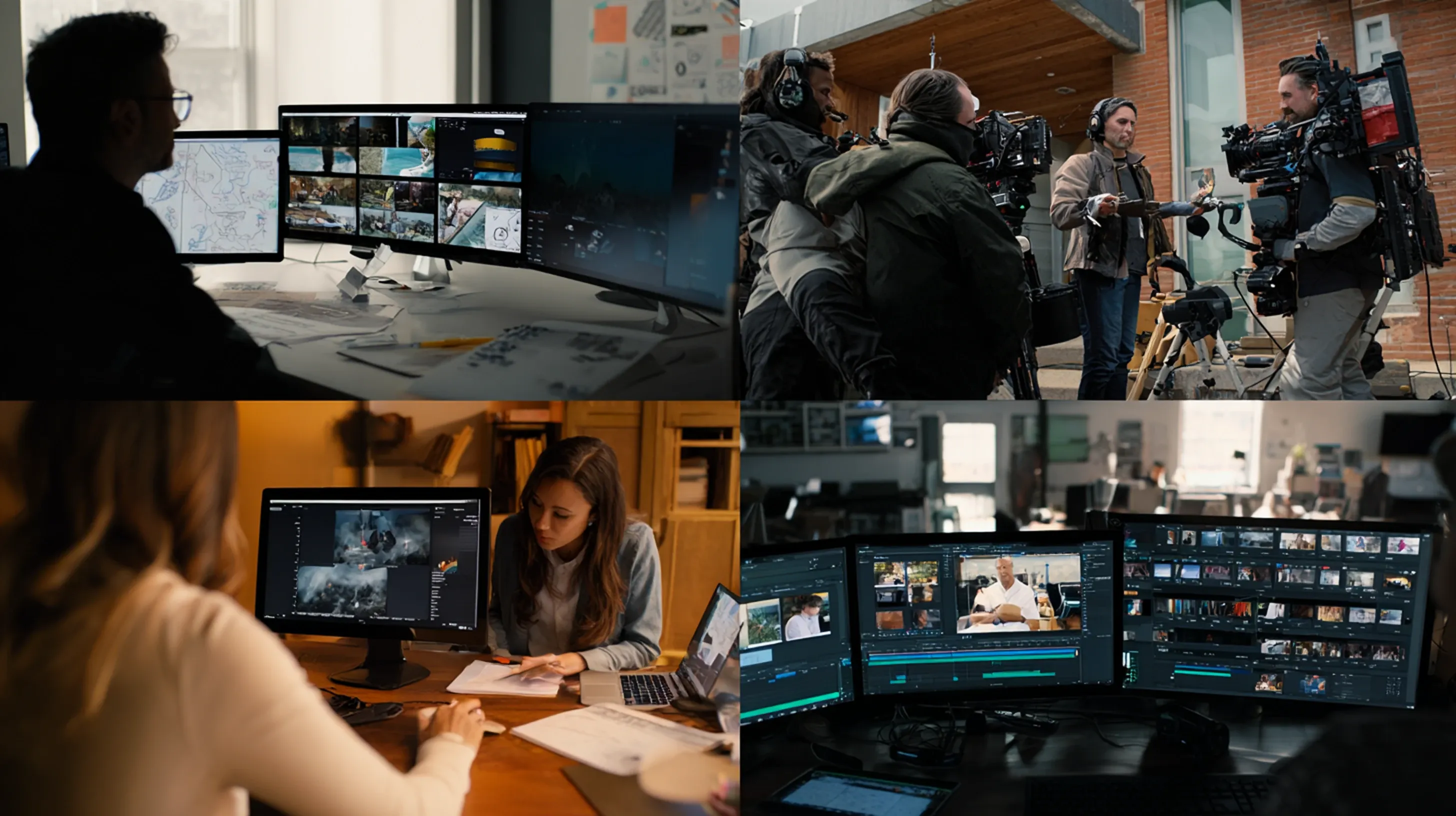
Collage showing video production, editing, and post-production workflows enhanced by AI-powered content creation tools.

A simple live-action shoot can sometimes skip formal storyboarding. A hybrid project can't. In video and animation production, this is the step where live-action shots and animated elements get mapped together, on the same page, before anything expensive gets built or filmed.

The reason is mechanical. The animation has to be designed around real footage, and the footage has to be framed around the animation, so both have to exist as a plan at the same time. Georgia Tech's library guide defines a storyboard as the visual sequence used to plan scenes, camera angles, and transitions before filming or editing. In hybrid work, that sequence also marks each graphic's placement and size, then shows its movement with the shot.

When the storyboard reaches you, review it against the brief and check a few things:

  • Where animated elements sit in each frame and whether the live shot leaves room for them

  • The pacing, so the timing of a graphic matches the moment in the footage it explains

  • That the animation style and brand look match what you signed off on

Your sign-off here is the cheapest insurance in the project. That planning document lets the team identify potential challenges and solve them in advance, which is far less costly than discovering on a shoot day that a frame has no space for the chart it needed. Approve carefully, because changing the plan after filming means reshooting or rebuilding.

Want to build something that hits?

Ideas are cool. But action's cooler. Tell us about your project and let's create content that lands fast, loud, and strategic.

Who does what on a hybrid team

You'll deal with more than one specialist on a video and animation production project, and knowing who owns what saves you from chasing the wrong person. The producer or project manager is your point person. They own the project plan and the budget, and they're who you talk to most.

The director shapes the creative and runs the shoot. Camera and on-set crew capture the footage. The animators and motion-graphics artists build everything that wasn't filmed from the storyboard you approved. The role that's unique to hybrid work is the on-set supervisor, sometimes a VFX supervisor, who keeps filmed shots compatible with the planned animation. One supervisor on a Reddit VFX thread framed the job well: the point is to help the camera team shoot it as if the animation were already there while the look stays with the creative team.

That supervisor exists because the live-action and animation teams have to stay aligned across every stage, with the handoff managed throughout the project. When the shoot accounts for scale and light that the animators will later match, the composite holds together. For you, the practical takeaway is short. You communicate through the producer, who keeps both teams synced while the supervisor protects the technical match as the camera rolls.

What you get at the end

A finished project is more than a single file, and knowing the full list lets you hold the team accountable before you sign off. At minimum, video editing services should deliver the final edited master in the agreed runtime and aspect ratio, plus caption files or burned-in subtitles. According to Jungle Films, a strong package also includes social cutdowns and raw footage so the video works across platforms and campaigns.

Most video and animation production deliverables fall into a predictable set:

  • The final master in your agreed length and resolution

  • Cut-downs in shorter runtimes, such as 30-second and 15-second versions

  • Aspect-ratio variants like 16:9 for YouTube, 1:1 for Instagram feed, and 9:16 for Reels or TikTok

  • Captioned files, since 254% more businesses captioned their videos in 2023 than the year before, per Wistia's 2024 report

  • Source or archive assets, with a ProRes master alongside an H.264 sharing file

The finishing work happens in post-production. Video editing services and final exports are part of that phase, with color grading and sound mixing handled there too, and most studios include two rounds of revisions in the quote. Plan your video editing services and platform versions from the start of the edit, because one production guide notes that last-minute reframing for vertical or adding captions after final delivery is costly and slow. What's not included by default is unlimited revisions or extra cutdowns beyond the agreed list, so confirm the scope in writing. Settle the deliverable list before the storyboard is approved and you'll know exactly what files arrive and in what formats.

Partner with a team that understands hybrid production

Hybrid productions succeed or fail in the planning. Combining live-action footage with animation, motion graphics, and visual effects requires close coordination between creative, production, and post-production teams from the earliest stages of the project. At XTRND, we help businesses manage that complexity by bringing strategy, filming, animation, editing, and motion design together under one production process.

Whether you're creating a product demonstration, an explainer video, a corporate campaign, or a branded content series, our team ensures every element works together seamlessly from storyboard to final delivery. If you're considering a hybrid video project and want expert guidance on what's possible within your budget and timeline, book a consultation with XTRND to discuss your goals and production requirements.

Planning your hybrid project

The decision and the video and animation production workflow connect at one point: hybrid earns its complexity when one format alone leaves a gap, and it costs you tighter planning to get there. You trade more upfront coordination across a synced two-team production and an extra storyboard sign-off for more creative control and a video that carries both human trust and visual clarity. If your budget and timeline can absorb that planning, the combination pays off.

The next step is simple. Bring a brief and a rough budget to a production conversation so a producer can tell you honestly what's achievable in your range. And if you've realized along the way that your project needs no real footage at all, the animation agency page is the better home for your video and animation production needs.

Want to build something that hits?

Ideas are cool. But action's cooler. Tell us about your project and let's create content that lands fast, loud, and strategic.

Plan animated overlays before filming starts. The storyboard should show each overlay’s position, size, and timing so the camera crew can frame shots with enough space. If overlays are added after the shoot without planning, the editor has fewer options and the production can need extra compositing work.

Expect to approve the script, visual style, storyboard, and shot plan before filming. These approvals give the director, camera crew, and animators the same reference. The client should check that each animated element supports the message and that the planned footage leaves room for it.

Yes, you can reuse hybrid video assets if the contract includes source or archive files. Ask for clean footage, final masters, caption files, and agreed animation assets. Confirm usage rights too, because licensed music, stock clips, or talent agreements can limit where and how long the video can run.

Hybrid production costs more because it needs tighter planning, filming, animation, editing, and compositing. The team has to match timing, scale, color, and lighting across filmed and animated elements. Extra cost usually comes from specialist labor and revision time, so scope the deliverables before the storyboard is approved.

Hybrid video and animation production can work on a small budget if the concept stays contained. Use fewer locations, limit animated elements, and choose one or two final aspect ratios. A producer can then build a schedule that protects the main idea without adding avoidable shoot or post-production costs.

Schedule a Meeting

Book a time that works best for you

You Might Also Like

Discover more insights and articles

Title:
Videos for Companies: Types, Examples & a Planning Checklist

Meta description:
Choose videos for companies that fit your goal, then use a simple checklist to write a brief you can share with a

Videos for Companies: Types, Examples & a Planning Checklist

This article walks you through the main types of videos for companies and presents each one as a repeatable pattern you can copy. Then it hands you a short planning checklist to turn your chosen type into a brief you can pass to a freelancer or agency.

Title:
Corporate videography services: what to expect & how to choose

Meta description:
Learn how corporate videography services fit your approval process, so you can set review gates and control fee

Corporate videography services: what to expect & how to choose

This article walks you through the governance and approval side of commissioning a corporate video inside a mid-to-large organization. It covers how to map your reviewers and sequence the review gates, with guidance on feedback control and vendor selection within your company's constraints.

Title:
Corporate Filming: Definition, Workflow, and Shoot-Day Checklist

Meta description:
Use corporate filming workflow and shoot-day checks so you can plan your video project with confidence.

Arti

Corporate Filming: Definition, Workflow, and Shoot-Day Checklist

This article walks you through corporate filming from the first vague request to the moment you hand footage to an editor. You will learn what the term covers. You will also see how the workflow fits together and what to confirm on set so you can run a shoot without pretending to be a director.

Title:
Film Services: Definition, Scope Checklist, and Brief Template

Meta description:
Use this film services guide so you can define project scope and prepare a clear brief for the right provider.

Film Services: Definition, Scope Checklist, and Brief Template

This article defines what film services actually cover in a strict film-industry sense and draws the line between production and lab work. It also provides a scope checklist and a film services template you can fill in before you contact a single provider.

Book a call

Got a brief or just a thought? Share it with our team and let's create bold content built for speed.

Close