Introduction
Modern technology alters the traditional production pipeline for brand filmmaking. For decades, premium brand storytelling required massive budgets, weeks of location shooting, and months of post-production to meet broadcast standards. Today, an AI studio film delivers the same visual quality without the rigid constraints of conventional high-budget shoots. This efficiency helps organizations personalize content across multiple channels because traditional methods cannot scale fast enough.
Organizations drive a rapid adoption of new production tools across the industry to solve this scaling problem. Recent data shows that 34% of organizations actively use video generation models, and this represents an 89% increase from the previous year. The following sections map the specific capabilities, workflows, real-world case studies, and strategic frameworks that define automated production.
AI Studio Film: New Production Paradigm
The term AI studio film describes a specific production methodology, not a novelty filter applied to stock footage. This methodology fuses three distinct disciplines into a single pipeline. Generative models produce imagery from textual or visual prompts. Visual effects compositing refines and layers that imagery into broadcast-grade sequences. Mobile or lightweight capture provides real-world footage as the foundation.
A raw text-to-video prompt produces something watchable. A professional-grade pipeline produces something broadcastable. The distinction matters because broadcast, theatrical, and high-end advertising standards demand consistent color science, stable motion, and resolution that holds up on large-format screens. Native 4K output from the latest models now meets those thresholds with precision that earlier tools could not approach.
From Generative Clips to Production-Grade Cinema
The Innovative Dreams project from Wonder Project and Luma illustrates this convergence in practice. The collaboration combined performance capture, virtual production, and generative models to shoot across 40 locations in a single week on one Los Angeles soundstage. A traditional production of that scope typically requires a month or more of location work. The hybrid approach saved time and gave directors the certainty that they could adjust each environment in real time instead of scheduling a costly reshoot.
This convergence separates consumer-grade clips from production-grade cinema. As AI filmmaking studios scale these pipelines, the gap between experimental output and professional delivery continues to close, and this prompts premium brands to adopt this technology permanently.
Why Premium Brands Move Now
Premium brands do not experiment with automated production. They install it as permanent infrastructure, and enormous market pressure drives that decision. Global advertising spend is forecast to surpass $1 trillion in 2026, and digital channels will grow by 6.7%. That growth concentrates in video, where global businesses compete for attention in feeds that refresh every second.
Production teams now treat generative tools as an essential planning layer rather than a post-production curiosity. During pre-production, these tools generate hyper-realistic visualizations of scenes, lighting setups, and product placements. A creative team iterates through dozens of visual directions in hours instead of commissioning test shoots that consume weeks. The AI brand film pipeline shortens the distance between concept and execution, and this compression gives organizations more room to refine the details that define brand positioning.
AI Studio Film: How XTRND Builds Faster, Smarter, Cinematic Brand Films
In practice, this shift is already operationalized by studios building fully integrated AI production pipelines. XTRND, for example, combines generative video models, visual effects compositing, and lightweight capture into a unified workflow designed for brand production at scale. Instead of treating AI as a standalone tool, the studio structures it as a production system—where pre-visualization, generation, and post-production operate as a continuous loop. This approach allows brands to move from concept to broadcast-ready assets within days while maintaining consistent visual language across formats and markets.
From Visual Consistency to Scalable Brand Authority
The authority of a brand's visual identity depends on consistency across every touchpoint. When the same cinematic AI video style carries from a hero film to a social cutdown to an in-store display, the brand narrative holds together. Automated pipelines maintain that consistency because they use unified style parameters instead of relying on different crews that interpret a mood board differently on different days.
The reliability of these systems explains why adoption accelerates rather than plateaus. Early adopters match the visual cadence their competitors now sustain across markets, and they gain significant cost efficiency while they maintain high quality.
Speed Without Sacrifice

The most persistent skepticism about automated production centers on a single question. Does faster mean worse? The evidence says no. According to a cost analysis by Genra AI, a traditional 60-second product video costs between $5,000 and $20,000 and requires a two-week timeline. Comparable ai studio film workflows compress both the budget and the calendar, and they maintain the original output quality.
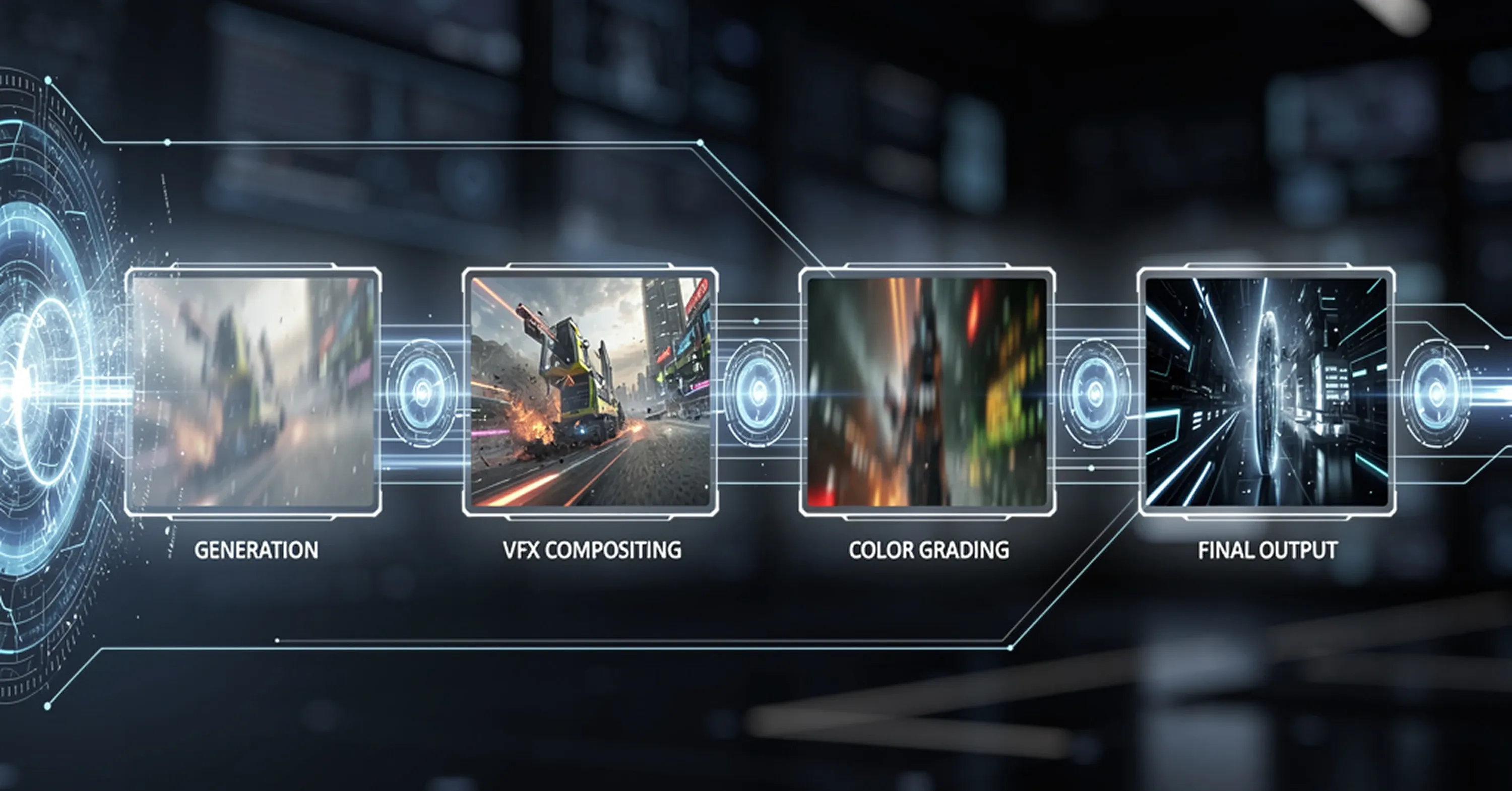
The quality assurance comes from the pipeline itself. Native 4K generation, visual effects compositing, and color grading operate as sequential checkpoints. Each stage validates the previous one. This pipeline produces footage with cinematic texture, stable motion, and sharp detail that meets broadcast requirements. This structured video generation process replaces guesswork with a predictable system where speed and fidelity reinforce each other.
The practical gains break down into four measurable categories:
-
Timeline compression: Projects that once required weeks of location scouting, shooting, and post-production now move from brief to final delivery in days.
-
Budget reallocation: Lower production costs free resources for distribution, media buying, and campaign personalization.
-
Iteration capacity: Teams produce multiple visual directions from the same source material and avoid early commitments to a single version.
-
Asset scalability: One production session simultaneously generates assets for hero films, social cutdowns, and regional adaptations.
These gains do not compromise high-end use cases. Organizations achieve these gains when they replace fragmented legacy workflows with integrated workflows, and this structural change delivers both speed and quality.
Integrated Workflow
A hybrid methodology defines the most effective AI brand film pipelines today, and that methodology follows a specific sequence. Mobile or lightweight capture collects real-world footage as source material. Enhancement models refine that footage to stabilize motion, upscale resolution, and adjust lighting. Visual effects compositing then layers generated environments, effects, and transitions over the enhanced base. The result is a unified asset that carries the texture of physical filmmaking and the flexibility of digital generation.
The command structure of this workflow matters as much as the tools within it. When capture, enhancement, and compositing sit inside a unified platform, teams avoid the fragmentation that plagues traditional post-production. Files do not travel between disconnected vendors. Color science does not shift between departments. A single team maintains creative control from the first frame to the final export.
From Production Speed to Real-Time Creativity
Real-time processing accelerates the execution further. The Innovative Dreams project demonstrated that directors could make editorial decisions because the virtual environment evolved alongside the performance. A team could walk onto a stage in the morning, build a world, film in that world, assemble footage, and edit it within the same day. That kind of speed does not just reduce production calendars. It changes the creative process itself because directors see results immediately and adjust on the spot. They no longer wait weeks for a rough cut.
Platform consolidation reinforces this integration. Unified systems now bundle multiple generation models, editing tools, and compositing engines under a single interface. This consolidation gives production teams fewer handoff points and fewer opportunities for quality loss between stages, and this efficiency delivers the highest impact across specific industries.
Where Technology Delivers Highest Impact
Automotive, tourism, and luxury sectors share a common need. Every frame must carry aspirational value. A single visual misstep erodes the trust that these sectors build over years. The support for adopting hybrid production pipelines grows strongest in industries where brand perception depends on consistent imagery across dozens of markets and hundreds of touchpoints simultaneously. Knowledge about how different AI production tiers map to these demands helps clarify which capabilities matter most for each vertical. The following subsections explain how these sectors deploy these pipelines to solve distinct creative challenges.
Cinematic AI Video in Automotive
Automotive companies sell motion, light, and surface detail. Every reflection on a hood and every shadow under a wheel arch communicates engineering philosophy. These automated pipelines handle these demands with the precision that vehicle advertising requires because generative models produce reflective surfaces and controlled lighting environments exceptionally well.
Lexus and agency AKQA demonstrated this when they released the "Energy That Drives You On" campaign. This campaign used AI and virtual methods and launched across EMEA. The campaign maintained the sleek aesthetic that luxury automotive audiences expect, and it shortened a production process that would have consumed weeks of studio time and location logistics. Tourism organizations face similar production demands and use these tools to scale their visual output.
Tourism Narratives
Destination marketing organizations face an unusual content problem. They need to sustain daily visual output across social, broadcast, and digital channels, and they must maintain the quality that inspires travelers to book a flight. Generative production pipelines solve both sides of that equation because they produce cinematic destination footage at a pace that traditional location crews cannot match.
The Saudi Tourism Authority recognized this early and developed an AI-powered smart guide named SARA. This guide personalizes visitor experiences at scale. That initiative signals a broader regional strategy where automated visual tools support the entire destination marketing ecosystem. These tools support everything from awareness-level hero films to granular social content that adapts to individual traveler interests. The luxury sector also requires this ability to generate personalized assets at scale.
Luxury Implementations
Fashion houses and premium retailers operate under a particular constraint where exclusivity must coexist with scale. A luxury brand needs thousands of personalized visual assets per season, yet each asset must feel handcrafted. Automated models resolve this tension and generate tailored content that maintains brand assurance across every variation.
Snapchat and Gucci illustrated this when they launched the "La Famiglia" AI Lens. This lens allowed users to try on collection personas through generative overlays. The activation turned passive viewers into participants. It also demonstrated that personalized AI-driven content increases engagement in luxury contexts and does not weaken brand perception. These luxury and tourism sectors currently drive massive content demands in specific global regions.
MENA as Epicenter
The Middle East and North Africa region does not just participate in the shift toward automated production. It leads adoption because the economic conditions and cultural ambitions of the region demand it. The regional luxury and tourism economies generate content requirements that outpace what traditional production infrastructure can deliver. This gap creates the ideal environment for AI studio film pipelines to establish authority as the default production method.
The numbers explain the momentum. Euromonitor projects the Saudi apparel and footwear markets and the UAE markets to reach $23 billion and $19 billion respectively by 2026. Markets of that size require a constant flow of premium visual content across physical retail, e-commerce, social platforms, and broadcast media. A single product launch might need dozens of localized campaign variants. Each variant requires calibration to a different audience segment and cultural context. Traditional production methods cannot generate that volume at the visual standard these markets require.
The AI brand film pipeline fills this gap because it produces localized, culturally sophisticated content, and it does not increase crew costs and production calendars. Saudi Arabia's Vision 2030 investments in tourism, entertainment, and creative industries further accelerate adoption. When a government commits billions to destination development and cultural infrastructure, the organizations that operate within that ecosystem need production capabilities that match the ambition. The creative sector in MENA does not wait for global norms to shift, and it sets the pace for adoption. However, rapid adoption introduces new challenges for organizations that need to maintain audience trust.
Authenticity and Trust
The strongest objection to automated brand production is not about quality or speed. It is about trust. Audiences form emotional connections with brands through perceived authenticity, and the introduction of synthetic media raises a legitimate question about whether generated content weakens that connection.
Research from Tarleton University found that luxury brands face negative consumer perception when they use AI-generated advertisements and disclose that usage. The study confirmed what many creative professionals already suspect. Transparency about AI involvement can trigger skepticism in premium contexts where audiences expect human craftsmanship.
From Replacement to Creative Augmentation
The solution is not concealment. The solution is integration. Cinematic AI video works best when it serves as an enhancement layer beneath human creative direction rather than a replacement for it. A creative director still sets the visual language, selects the narrative arc, and makes the editorial decisions that give a brand film its emotional weight. Generative tools accelerate the execution of those decisions. They produce options faster, visualize concepts earlier, and handle repetitive production tasks that consume human energy and do not add creative value.
This perspective changes the perception equation. When audiences see a finished brand film that carries genuine creative intent, the reliability of the production method matters less than the emotional resonance of the result. The brands that navigate this well treat automated pipelines as instruments in the hands of skilled filmmakers rather than autonomous replacements. Authenticity comes from the creative choices made by people, and these creators rely on professional tools to execute their premium productions.
Tools Behind Premium Production
The platforms behind modern AI studio film workflows function as production infrastructure, and they do not operate as consumer applications. Each tool addresses a specific stage in the automated video pipeline, and the choice between them determines the level of command a production team maintains over the final output. Knowledge about these platforms helps production teams build an AI brand film pipeline with the precision that premium clients require.
Current market data from Digital Applied shows that Sora holds 28% of market share, and Runway follows at 24%. That distribution reflects how quickly enterprise-grade generation tools have consolidated around a small number of production-focused platforms. The leading tools for professional content creation share common traits. These traits include native high-resolution output, commercial licensing clarity, and controls designed for filmmakers rather than casual users.
The platforms that shape premium production include the following systems:
-
Kling AI represents the first platform to deliver native 4K output. This platform meets the resolution and detail thresholds required for broadcast, theatrical, and large-format advertising placements.
-
Shutterstock AI Video Generator operates as a unified platform that bundles models from multiple providers under a single interface with built-in commercial licensing. This setup removes legal ambiguity for brand campaigns.
-
Artlist AI Toolkit and Original 1.0 model function as a filmmaker-focused system that provides detailed creative controls over motion, pacing, and visual style. The system does not treat generation as a single-prompt process.
-
Innovative Dreams hybrid methodology acts as a production approach that combines LED virtual production stages with generative models. This methodology allows directors to capture performance and build environments simultaneously within a single session.
These systems are not interchangeable. Each occupies a distinct position in the production chain. The most effective pipelines combine several of them within a unified workflow, and they do not rely on any single platform to handle every stage. This strategic approach defines how the industry moves forward.
Conclusion
To summarize our discussion, the transition to automated production permanently changes how organizations deploy premium content. An AI studio film provides three core advantages that improve brand storytelling. These advantages include high visual quality through native 4K output, faster timelines, and scalable personalization across markets. Organizations that adopt these capabilities early set new industry standards. As this technology matures, these organizations will continue to operate more efficiently. Companies evaluate their current workflows against these benchmarks and often engage production partners to establish a reliable production pipeline.